
Submissions on the Employment Relations Bill No 27 of 2025

The consultative and good faith approach in employment relations exemplified by the Employment Relations Act of 2007 appears to have completely disappeared in the proposed Employment Relations Bill No 27 of 2025 to the detriment of both labour/workers and capital/industry in Fiji.

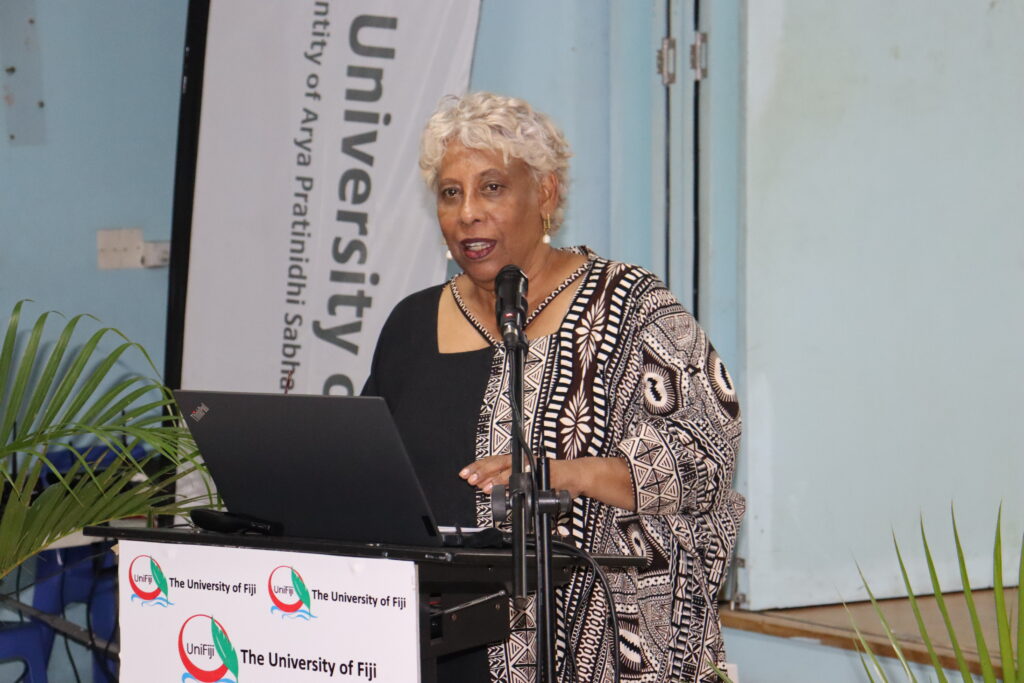
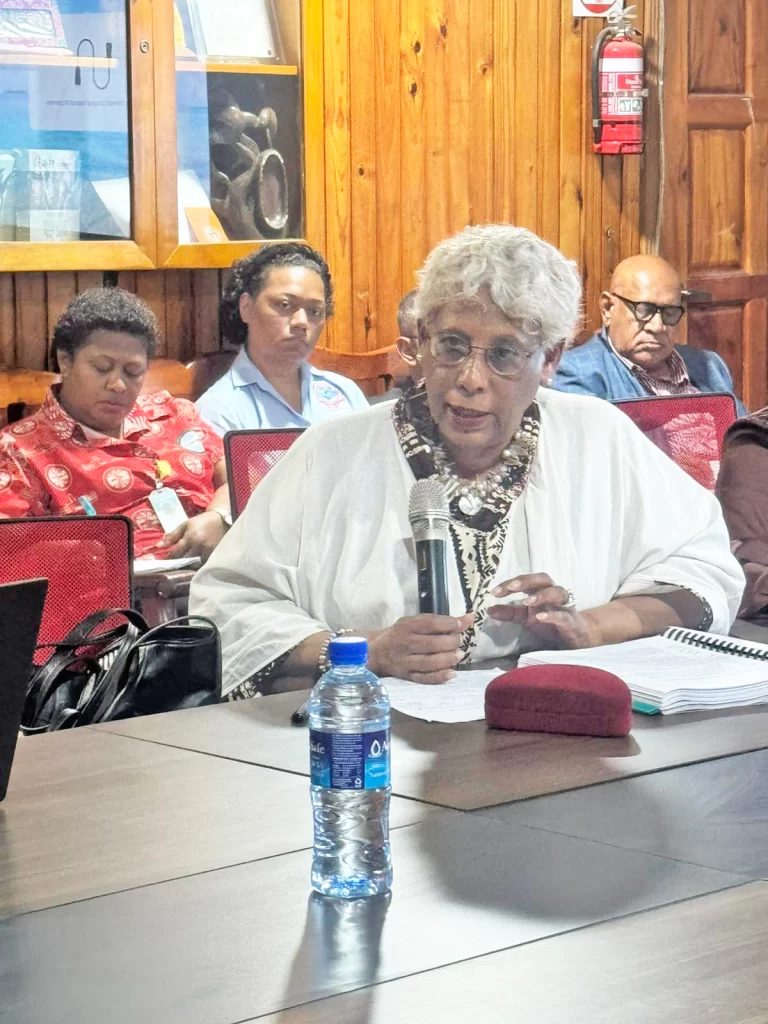
This was stated by the University of Fiji Vice Chancellor, Professor Shaista Shameem, in the University’s submissions to the Parliamentary Standing Committee on Economic Affairs at its public hearing in Suva today.

Professor Shameem said there was a fundamental flaw in the Bill which affected the entire scheme of the proposed legislation; the question of whether compulsory unionism in Fiji was being proposed by the wording of section 6 (5).  The new section 6 (5) stated that a ‘worker must voluntarily join a trade union’ which was a contradiction and did not make any sense, since the word ‘must’ was mandatory but the word ‘voluntarily’ gave a choice. She told the Committee that the new section 6 (5), if included in the legislation, would be an oxymoron and meaningless. The resulting confusion as to whether unionism would be compulsory in Fiji would lead to massive labour/capital instability and cause industrial chaos and conflict, she said. “Nothing can be mandatory if voluntary”. The proposed section 6(5) will violate the freedom of association provisions in the International Labour Organization’s legal framework and Fiji’s constitution.

Due to the major flaw in section 6(5), the entire Bill was difficult to understand and would be impossible to apply if it became law, Professor Shameem said. Clauses had become ambiguous and difficult to implement.

“A related problem is that the ERA 2007’s Labour-Management Consultation and Cooperation Committees (LMCC) has also become a casualty of the proposed system because it has been deleted from the draft legislation”. Professor Shameem said that, as a result, the original sentiment of the ERA 2007, namely, fair labour practices, good faith, structure of rights and responsibilities of both worker and employer and consultation between labour and management in the workplace had also been diminished if not disappeared altogether. This was evidenced by the heavy, and somewhat draconian, penalties imposed for breaches of the proposed legislation.

Another problem was the unnecessary extension of time for disputes to be resolved, from 12 months in ERA 2007 to 6 years in the draft, which would encourage enduring conflicts and affect productivity. The super powers given to labour officers to undertake what might normally be judicial responsibilities in issuing search and seizure warrants would prevent any independent scrutiny of public officers’ exercise of authority.

Furthermore, the meaningless allocation of menstruation leave as part of sick leave and not additional leave, when menstruation was a privacy issue for many women and discussion of it culturally taboo in certain contexts, defied common sense, said Professor Shameem.

Another problem with the proposed legislation was the inclusion of police and corrections officers when the RFMF was excluded. Police, prison and military officers were formerly excluded in the ERA 2007 for good reason so that those in these services were readily available in times of national security and public interest. Normally known as the ‘Disciplined Services’, and seen as an essential service for people’s safety, the military, police and prisons had their own internal mechanisms of personnel protection and it was unclear why this had to be changed to allow only two of these services to be included in the proposed legislation. Whether the new provisions on police had been drafted in accordance with the Police Act, which was currently being revised, with the University of Fiji also making submissions on it, was not clear, Professor Shameem said.

Furthermore, the term ‘essential services’ in any proposed legislation had to be defined very carefully as past practice had been to arbitrarily include all sorts of industries in essential services on a whim. Bill No 27 should define essential services as those delivered in the public interest and, thus, responsibilities of workers in these services had to be fully understood if any limitations were to be placed on their rights, Professor Shameem said.

The University emphasized that protecting workers does not require excessively punitive or vague legislation. Instead, Fiji needs clear definitions, proportionate penalties, fair appeal rights, judicial oversight, and compliance models that encourage a labour/capital consultative process. Professor Shameem said that both workers and industry were engaged in a joint enterprise for individual, collective and national productivity and growth and the government was obliged to facilitate harmonious relations between the two as a matter of public interest. A clear purpose for the amendments was needed as legislation affecting everyone’s rights and responsibilities had to be unambiguous, she said.

The fundamental principles contained in ERA 2007 were still relevant and appropriate, however the decrees that came after 2009 should rightly be reviewed with a red pencil, Professor Shameem said. “But throwing the baby out with the bathwater is not good legislative review practice” she told the Committee.

Professor Shameem said that while many of the clauses in the proposed legislation suffered from clumsy drafting despite good intentions, the major flaw was the new section 6 (5) which would cause instability within the ranks of both employer and employee and, therefore, the nation as a whole.

She said the public should be fully aware whether the intention of the government was to inflict compulsory unionism on every worker or whether people had a choice. Professor Shameem said this was a policy matter and the government had to come clean on the exact meaning of section 6 (5) of Bill No 27.

Loading

The University of Fiji Supports Reintroduction of Scaling in National Examinations

The University of Fiji has voiced its support for the Government’s decision to reintroduce the scaling of marks across all national examination levels from 2026, as long as it is an equitable and evidence-based reform that promotes fairness, consistency, and comparability in student assessment outcomes.

The University believes that, normally, scaling, if applied transparently and scientifically, enhances the credibility of national examinations and ensures that all students, regardless of their school location or resources, are assessed on a common and equitable basis.

The University of Fiji Vice-Chancellor, Professor Shaista Shameem, said that while the topic of scaling in education remains a complex and often debated issue, it is important to approach it with both academic integrity and compassion for students’ diverse learning abilities.

“I have myself always personally opposed scaling as a learning methodology because I have felt that scaling merely hides the fact that there are no universally agreed concepts of academic success and academic failure,’ she said.

Professor Shameem said she does not believe that there is anything such as ‘failure’ especially when it comes to young minds. ‘Everyone is worthwhile in my books and if schooling does not suit some people, as long as they receive an education, I support responsible choices in learning,’ she said.

Nevertheless, Professor Shameem said her academic staff at the University had convinced her that the University should support the Education Ministry’s scaling policy as long as it was carried out with checks and balances in place, and by providing the University’s own guidelines to the Ministry, she said.

Elaborating on the academic and technical principles behind scaling, Associate Professor and the Head of the Science Department in the School of Science and Technology, Dr. Ramendra Prasad, explained that scaling is a statistical process used to transform raw marks from different examinations or subjects onto a common metric.

“Scaling is not about inflating or reducing marks,” Dr. Prasad said. “It compensates for inherent differences in exam difficulty, teacher instruction, and marking approaches, ensuring that all student performances are assessed fairly across subjects, schools, and years.”

He said that national examinations involve large cohorts of students and multiple markers across Fiji, which inevitably introduces small variations that scaling helps to correct. This process allows tertiary institutions and employers to make more equitable decisions about admissions, scholarships, and placements.

He also highlighted that transparency and consistency are essential to maintaining public confidence in the system.

“The integrity of the scaling process lies in its transparency and technical accuracy,” he said. “Student rankings must remain intact, high achievers should not be penalised, and low achievers should not be unduly advantaged. A zero should remain zero, and a perfect score should remain perfect.”

He added that well-designed scaling systems use standardised statistical models, such as the normal distribution, to ensure that exam results can be compared objectively across different subjects and years.

The University further noted that scaling supports Fiji’s long-term educational goals by encouraging students to take up challenging subjects such as science, technology, engineering, mathematics (STEM), computer studies, and commerce fields critical for national development and economic competitiveness.

While acknowledging ongoing public discussion, The University of Fiji maintains that scaling, when implemented with rigour, transparency, and consistency, strengthens the credibility of Fiji’s education system and promotes equal opportunity for all learners.

The University of Fiji remains committed to supporting education policies that are grounded in research, fairness, and international best practice.

Public Relations Office

Loading

The University of Fiji Joins the World in Commemorating United Nations Day 2025

The University of Fiji proudly joins the global community in marking the 80th anniversary of the United Nations (UN), an institution that continues to shape a world founded on peace, human rights, and sustainable development.

United Nations Day, observed annually on 24 October, celebrates the entry into force of the UN Charter in 1945, a milestone that reaffirmed humanity’s collective commitment to preventing war and promoting global cooperation.

As a higher education institution deeply rooted in the Pacific, The University of Fiji recognizes the United Nations as an enduring pillar of international solidarity.

The University of Fiji Vice-Chancellor, Professor Shaista Shameem notes that Fiji’s contributions to UN peacekeeping operations, climate diplomacy, disaster relief, gender equality, and human rights protection underscore its strong alignment with the UN’s mission.

‘In a world where the moral compass is sadly and hopelessly askew, the UN can show us the light at the end of the tunnel’, she said. ‘At times even that light appears dim but nations can stand together, at least on UN Day, and protect it from ever going out’. The University of Fiji stands at the forefront to ensure that the international legal standard at the base of the UN system retains its integrity over time and geographic space much as it’s so hard to do, Professor Shameem said.

She said that UniFiji further commends the Fijian Government’s initiative to establish a centralized UN House to host all UN agencies in the country. This development is expected to strengthen Fiji’s role as a regional hub for the Pacific, enabling more efficient coordination and collaboration among UN agencies working across diverse development priorities.

The University of Fiji also draws inspiration from the UN Secretary-General, Antonio Guterres, whose message for this year’s UN Day captures the enduring spirit of the organization.

“The United Nations is more than an institution. It is a living promise spanning borders, bridging continents, inspiring generations. For eighty years, we have worked to forge peace, tackle poverty and hunger, advance human rights, and build a more sustainable world together.”

Reflecting on this milestone, UniFiji reiterates its own commitment to advancing education, peace, equality, and sustainability, values that stand at the heart of both the United Nations and The University of Fiji’s mission to create a more just and resilient world.

Public Relations Office

Loading

UniFiji Hosts Landmark Regional Surgical Conference, First-Ever Collaboration Between PISA, RACS and G4 Alliance

The University of Fiji proudly hosted a historic international conference at its Samabula Campus, bringing together the Pacific Islands Surgeons Association (PISA), the Royal Australasian College of Surgeons (RACS), and the G4 Alliance for the first time ever to advance collaborative surgical development across the Pacific region.

The three-day event marked a major milestone for the Pacific’s health sector, attracting leading surgeons, medical specialists, policymakers, and students from Fiji, Tonga, Samoa, Cook Islands, East Timor, New Zealand, and Australia.

The conference focused on strengthening regional surgical training, improving public health integration, fostering research, and enhancing access to safe surgery, particularly for remote island communities. It also provided a global platform for budding Pacific surgeons to present clinical audits and research projects while encouraging multidisciplinary collaboration and knowledge sharing.

UniFiji Vice-Chancellor Professor Shaista Shameem emphasised that hosting this groundbreaking collaboration reinforces the University’s role in shaping the future of healthcare in the Pacific.

“This conference provided an opportunity for the University of Fiji to showcase its expertise alongside colleagues from the region. ‘The papers presented illustrated the complex topics regarding healthcare in the region. While the challenges are myriad in nature and scope, we see that collaboration with other medical personnel at senior level and the Ministry of Health in Fiji, we can find solutions that are appropriate for both Fiji and the wider Pacific’ she said. Professor Shameem said that the University was in the process of determining how to add value to medical research in the region through MOUs and partnerships between the Umanand Prasad School of Medicine and Health Science and other universities and medical research institutes in the region.”

President of PISA and Professor of Surgery at The University of Fiji, Professor Ifereimi Waqainabete acknowledged the significance of this partnership and highlighted that this conference is truly a landmark achievement for the Pacific.

“It is the first time that the Pacific Islands Surgeons Association, the Royal Australasian College of Surgeons and the G4 Alliance have collaborated to deliver a unified platform for advancing regional surgical practice. By hosting this historic gathering, the University of Fiji has demonstrated its growing capacity to contribute to surgical training, leadership development and improved access to care across our Pacific Island nations.”

“We are proud that this forum has enabled our surgeons to share innovations, discuss solutions to our shared challenges, and invest in the next generation of Pacific clinicians. The commitment shown here reflects our collective responsibility to ensure safer surgery, stronger systems and a healthier future for all Pacific peoples.”

Dr. Abhijit Gogoi, Associate Professor at the Umanand Prasad School of Medicine & Health Sciences (UPSM & HS), also emphasized on the importance of the event.

“Hosting the PISA–RACS–G4 Alliance was a landmark event for UPSM & HS. It provided our staff and students an exceptional opportunity to engage with eminent regional and international surgical leaders, including the Fijian Minister for Health, Hon. Dr. Antonio Lalabalavu, and WHO WPRO Regional Director, Dr. Saia Piukala. We were especially proud to have Professor Ifereimi Waqainabete Professor of Surgery at UPSM & HS, University of Fiji, and a pioneer of this conference deliver one of the keynote addresses, setting the tone for collaborative regional surgical advancement.

“Exposure to such a high-level forum on global surgery, innovation, and regional collaboration has been invaluable. For our students, it was an inspiring platform to witness academic excellence in action, network with leading surgeons, and understand the broader context of surgery within global health. For our faculty, it reaffirmed our commitment to advancing surgical education, research, and capacity-building in the Pacific. This collaboration exemplifies how UniFiji continues to bridge education, research, and community service in pursuit of better health outcomes for our region.”

This landmark collaboration has set a new benchmark for regional medical cooperation. The University of Fiji looks forward to continuing its role as a hub for global–Pacific partnerships that enhance clinical expertise, strengthen health systems, and inspire the next generation of healthcare leaders.

Public Relations Office

Loading

University of Fiji Signs MOU with University of Canterbury to Strengthen Academic and Research Collaboration in Oceania

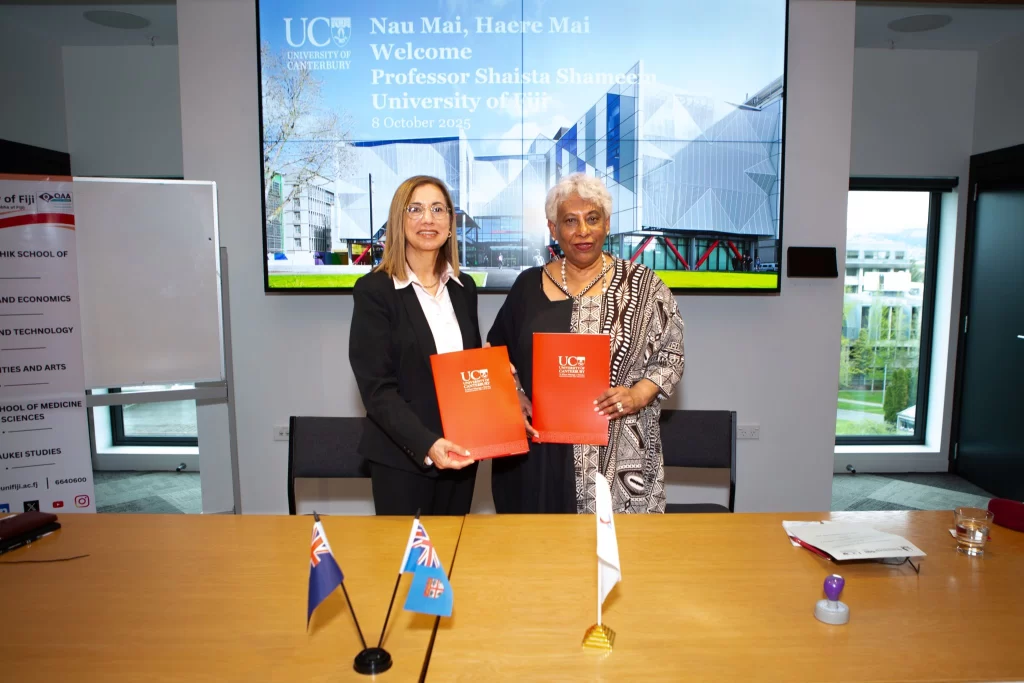
The University of Fiji and the University of Canterbury (NZ) have signed a Memorandum of Understanding (MOU) to promote academic and research cooperation between the two institutions.

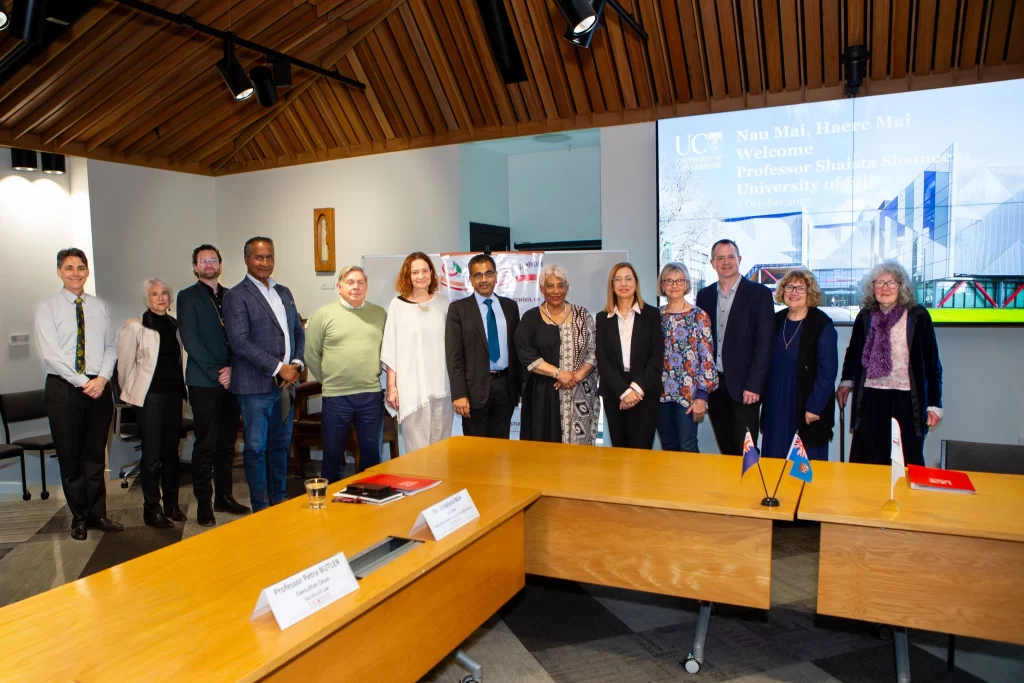
The agreement, signed on 8 October 2025 by UniFiji Vice-Chancellor Professor Shaista Shameem and UC Vice-Chancellor Professor Cheryl de la Rey, establishes a framework for collaboration that recognises the shared commitment of both universities to advancing higher education, innovation, and cross-cultural academic exchange.

The ceremony was attended by the Executive Deans of the University of Canterbury, including Distinguished Professor Steven Ratuva who is the Pro-Vice Chancellor and Director of the Macmillan Brown Centre for Pacific Studies at the University of Canterbury. The event also saw the presence of Professor Shameem’s UC Alumni Sociology Masters Class of 1983, Professor Rosemary Du Plessis, Ms Jenny Lee and Ms Joanne Neilson.

Addressing the University of Canterbury Vice Chancellor and Executive Deans, UniFiji Vice-Chancellor Professor Shaista Shameem said that not only was she a proud Alumni of the University of Canterbury, having graduated with a Master of Arts in 1983, but she also found it significant that, more than 40 years later, she had returned to sign a MOU between her old university and her current one, UniFiji. ‘Having my friends from the Sociology Class of ’83 witness the event was special and served to consolidate the deep-seated connections between the University of Fiji and the University of Canterbury with its historical credentials and top ranking’, she said.

The Vice Chancellor of Canterbury University, Professor Cheryl de la Rey said that under the MOU, the two universities will establish a framework for collaboration in several key areas, including:

  • Exchange of academic materials and resources, Faculty in all areas of knowledge and disciplines, staff, and students;
  • Development of joint research programmes and academic projects of mutual interest;
  • Co-sponsorship of symposia, seminars, and conferences;
  • Cooperation in the development of education and training programmes, with potential for joint degree offerings.

She said that with the shared vision for promoting academic excellence and collaborative learning between the two universities, the academic advancement in the region will be consolidated and enhanced.

The new partnership underscores UniFiji’s ongoing efforts to build international academic linkages that enhance the quality of higher education and research across the Pacific. It also aligns with the University’s Strategic Plan focus on ‘Research and Innovation and Community Engagement’, reinforcing its commitment to developing future-ready graduates equipped for global citizenship.

Public Relations Office

Loading