
University of Fiji Academic Receives International Recognition for Educational Leadership

The University of Fiji is proud to announce that Dr. Mohini Devi has been internationally recognised by the Commonwealth Council for Educational Administration and Management (CCEAM) for her outstanding contribution to educational leadership and youth empowerment across the Pacific.

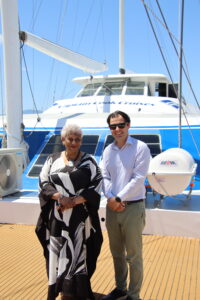
Dr. Devi received the award from Dr. Venesser Fernandes, Chair of the CCEAM Youth Leadership Special Interest Group (SIG) from Monash University, Australia. The presentation was made in recognition of Dr. Devi’s exceptional work with the CCEAM Fiji Chapter, which has successfully elevated Fiji’s voice and visibility in the global education leadership community.

Vice-Chancellor, Professor Shaista Shameem, commended Dr. Devi for her achievement, describing it as a moment of pride for the entire university community and a reflection of UniFiji’s growing international presence.

Professor Shameem said that in an era where most people are confused about the attributes of true leadership that can take a community or nation forward, to have a University of Fiji female academic recognised internationally for her leadership in higher education was a recognition also of the University of Fiji’s exemplary academic record.

Dr. Devi expressed that the honour represents more than just a personal achievement, it reflects the collective effort of her colleagues, mentors, and communities who share a vision for advancing youth leadership and inclusive education.

“This acknowledgment reflects not only my personal effort but also the collective commitment of colleagues, mentors, and communities who share a common vision for advancing youth leadership across the Commonwealth,” she said.

“It reinforces that whether we are working in policy, educational leadership, or academic research, we all contribute to a larger mission which is building education systems that prepare our young people not only for employment but for engaged, ethical, and compassionate citizenship.”

Through her involvement with the CCEAM Fiji Chapter, Dr. Devi has coordinated several youth leadership initiatives, including International Youth Leadership Seminars, CCEAM Youth Leadership Symposiums, and Essay Competitions for emerging youth leaders. Her work has also focused on mentoring young people to lead community-based projects that address major issues such as food insecurity, climate change, and peacebuilding.

“Food insecurity, climate change, and peace are deeply associated challenges that greatly impact the lives and futures of young people in Fiji and across the Pacific,” Dr. Devi said.

“Empowering them to engage with these issues means investing in a future where Pacific communities are resilient, equitable, and hopeful.”

Dr. Devi emphasised that this international recognition highlights Fiji’s leadership in championing youth-focused educational reform and ethical leadership development across the Commonwealth.

She also noted the vital partnership between The University of Fiji and international organisations like CCEAM, which together can build stronger global networks that nurture innovation, resilience, and inclusivity among young leaders.

“The University of Fiji provides a vital local context by offering culturally relevant education, research expertise, and community connections that ensure leadership programmes are grounded in the realities of Fijian youth,” she explained.

She highlighted that international partners like CCEAM bring broader resources, global networks, and opportunities for capacity building and by working together, we can foster youth leadership that benefits Fiji, the Pacific, and the wider world.

Loading

FINAL EXAMINATION TIMETABLE – SEMESTER 2, 2025

Dear All

Greetings from the Office of the Registrar!

Please find attached the Semester 2, 2025 Final Examination Timetable. Refer to the link below to access the Examination Timetable for Semester 2, 2025: https://www.unifiji.ac.fj/exam-timetable/

For any queries please contact the Examinations Office via email: exams@unifiji.ac.fj

Wish you all the best in your Final Examination.

Kind Regards

Office of the Registrar

Loading

Captain Cook Cruises Fiji and the University of Fiji Strengthen Maritime Capacity Ahead of IMO World Maritime Day 2025

Port Denarau, Fiji – 18 September 2025 – Captain Cook Cruises Fiji (CCC) and the University of Fiji come together to mark the International Maritime Organization’s (IMO) 2025 World Maritime Day theme: “Our Ocean, Our Obligation, Our Opportunity.”

The joint efforts build on the GSTC2025 Global Sustainable Tourism Conference held in Fiji and coincide with the IMO’s new Regional Presence Office in Suva, which will drive capacity development and skills-building on maritime safety and environmental standards, and advance the Pacific’s blue economy, a sector closely tied to cruise and marine tourism.

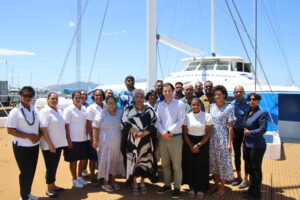
As part of the initiative, students, faculty, and the Vice-Chancellor toured CCC’s vessel Fiji One, learning from experts about the full range of maritime and marine science skills, training, certifications & experiences required to operate in the industry in line with IMO regulations, both nationally and globally. This was followed by conference-style discussions on board with CCC’s multidisciplinary team highlighting CCC’s platforms for capacity development and skills-building.

Allison Haworth West, Executive Director of Captain Cook Cruises Fiji, said “with our long history pioneering marine science and sustainability tourism in Fiji, Captain Cook Cruises provides in-field classrooms for marine sciences and maritime training, serving as a floating classroom and a platform for IMO sea-time training and underwater marine research. Operating daily Island and Reef, plus Sunset Sailings, CCC is not just a tourism operator but a hub for maritime, marine science, and eco-tourism capacity building”.

In marking World Maritime Day 2025, this academic–industry partnership demonstrates opportunities for multi-disciplinary training and hands-on capacity building at sea, including work directly with coral reefs, addressing the multiple threats identified under UN Sustainable Development Goal 14 – Life Below Water.

The Vice Chancellor of the University of Fiji, Professor Shaista Shameem said the offer of partnership from Captain Cook Cruises to join them on sustainable missions to restore coral reefs, provide students with a floating marine science laboratory, as well as cadetships in marine biology and to assist the company with ecotourism projects was more than the University had ever dreamed about. The University had moved it’s curriculum towards practicals and attachments from year 1 in as many programmes as possible so that students would be work ready when they joined the workforce after graduating.

Professor Shameem said the opportunity provided by Captain Cook Cruises was much appreciated by the University as it added value to the University’s science work in support of SGS 14, Life Below Water, in partnership with scientists and environmentalists working on Captain Cook vessels.

She said the students will have the chance to work with these scientists and experts to help replant coral gardens, research the extent of threats to our coral reefs and help with other regenerative oceans work on behalf of planet earth.

Professor Shameem said the University was working on the idea of developing a marine park and the partnership with Captain Cook Cruises would accelerate that initiative a lot more.

The MOU between the University and Captain Cook Cruises is being developed and will be signed as soon as a suitable date is found.

Loading

UniFiji Professor Recognised Among World’s Top 2% Scientists for Third Consecutive Year

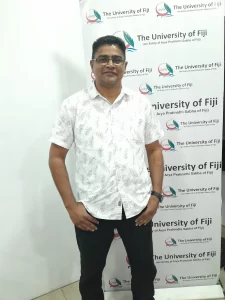
The University of Fiji is proud to announce that Dr Ramendra Prasad, Associate Professor and the Head of the Science Department at the School of Science and Technology has once again been recognised in the World’s Top 2% Scientists List for 2025, compiled by Stanford University in partnership with Elsevier.

This marks the third consecutive year that Professor Ramen’s name has been featured, a remarkable achievement that highlights his ongoing contribution to cutting-edge research in Enabling & Strategic Technologies, particularly Energy and Environmental Engineering.

The list, widely regarded as one of the most prestigious global rankings of researchers, is based on the citation impact of scientists across diverse disciplines.

Vice-Chancellor of the University of Fiji, Professor Shaista Shameem, congratulated Professor Prasad highlighting the importance of this recognition.

“This recognition for Associate Professor Prasad is once again an accolade for him professionally and for the University of Fiji’s extending repertoire of achievements in the intellectual arena.”

She said the University, since its Higher Education Commission Review in 2024, had moved firmly towards ensuring that it’s main concentration, as a research active University, was to record high level publications including through its own University of Fiji Press. Professor Prasad was one of UniFiji’s preeminent scholars; his work focused on the very significant area of science, especially environmental science and, as such he was a mentor for early career academics at the University.

Reflecting on the recognition, Professor Prasad said that being ranked among the World’s Top 2% Scientists for the third consecutive year is both humbling and motivating.

“It is a personal honour and a professional validation of the research I lead and contribute to, which has global relevance and impact. This recognition affirms years of persistence, collaboration, and dedication to advancing knowledge while addressing real-world challenges in renewable energy and environmental sustainability.”

Professor Prasad’s research spans areas such as machine learning and AI applications for renewable energy forecasting, waste-to-energy solutions tailored for Pacific contexts, and environmental monitoring systems for air, water, and flood forecasting. His work bridges theory and practice, ensuring real-world impact and international visibility.

Professor Prasad emphasised that the honour reflects not only individual effort but also UniFiji’s growing research culture:

“This recognition highlights UniFiji’s capacity to produce research of international calibre despite limited resources. It strengthens our reputation as a Pacific hub for renewable energy, climate resilience, and environmental engineering research.”

Through programmes such as the MSc in Renewable Energy Management, MSc in Environmental Science, and PhD pathways, UniFiji continues to cultivate the next generation of scientists and innovators.

He noted the importance of inspiring students and young researchers and mentioned that this achievement illustrates that impactful global recognition is possible from Fiji.

“Several of my MSc students are already working on applied research in solar, hydropower, biogas, and offshore wind, highly relevant to regional sustainability. Seeing their supervisor’s work recognised globally motivates them to pursue innovative, high-quality projects.”

Looking ahead, Professor Prasad plans to expand UniFiji’s contribution to the field through strengthening postgraduate and research programmes in renewable energy and environmental sciences, attracting more international collaborations and external grants, mentoring MSc and PhD students to build a new generation of researchers and Serving as a Review Editor for the Intergovernmental Panel on Climate Change (IPCC) Seventh Assessment Report (AR7).

He also envisions new collaborations in smart grid applications, hydrogen energy, and AI-integrated environmental modelling, positioning UniFiji as a hub for advanced, contextually relevant clean energy research.

Loading

Drua Project Coordinator Represents UniFiji at BBJN Conference

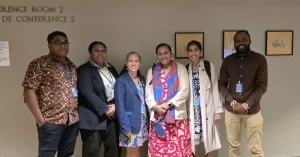
The University of Fiji’s Drua Project Coordinator, Mr. Setareki Ledua, proudly represented UniFiji at the Biodiversity Beyond National Jurisdiction (BBNJ) Preparatory Commission held on Thursday, 28 August 2025, at the United Nations Headquarters, New York.

Mr. Ledua advanced UniFiji’s voice in global conversations on inclusive ocean governance and traditional knowledge, ensuring that the Pacific and the University of Fiji were both visible at this important international forum.

This participation provided not only an opportunity to stand for the Pacific but, most importantly, to showcase the University of Fiji on the international stage.

The BBNJ Agreement is a new, legally binding instrument under UNCLOS focused on conserving and sustainably using marine biodiversity in areas beyond national jurisdiction (ABNJ), which make up nearly two-thirds of the ocean. As the third implementing agreement under UNCLOS, it addresses key gaps in ocean governance across four pillars: marine genetic resources and benefit sharing; area-based management tools including marine protected areas; environmental impact assessments; and capacity building and transfer of marine technology. Adopted in 2023, the treaty will enter into force 120 days after the 60th ratification is deposited with the UN Secretary-General.

A distinctive feature of the BBNJ Agreement is its recognition of Indigenous Peoples and Local Communities (IPLCs), including provisions for integrating traditional knowledge alongside science, participation in governance, and dedicated funding to support IPLC conservation programmes.

Reflecting on his participation, Mr. Ledua said his involvement at the BBNJ Preparatory Commission elevated the University of Fiji’s visibility in international policy forums while creating new opportunities for the institution. He highlighted that this representation opens practical pathways for collaborative research and teaching in areas such as ABNJ conservation, ocean law, and traditional knowledge. It also encourages student and staff engagement with emerging BBNJ institutions, including the Scientific and Technical Body and the Clearing-House Mechanism, while fostering partnerships for capacity building and technology transfer that prioritize Pacific needs and perspectives.

Mr. Ledua further stressed the importance of policy influence, particularly through proposals to embed IPLC leadership via an IPLC Advisory Mechanism to guide area-based management tools (ABMTs), environmental impact assessments (EIAs), capacity building initiatives, and fair benefit-sharing.

Speaking at the conference he emphasized that the “Indigenous Peoples and Local Communities are not peripheral to ocean governance, they are central. Their ancestral knowledge, cultural practices, and lived stewardship offer not only wisdom but solutions for the challenges we face in protecting biodiversity beyond national jurisdiction. The BBNJ Agreement must not be implemented in isolation from those who have safeguarded marine ecosystems for generations. Inclusion is not charity – it is justice. It is effectiveness. It is resilience. We call on all delegates, institutions, and partners to ensure that IPLC voices are not just heard but embedded in the heart of BBNJ implementation. Let this event be the beginning of a sustained commitment to co-governance, equity, and respect. Together, we can shape a future where the ocean is protected not only by policy – but by people.”

Vice-Chancellor, Professor Shaista Shameem, congratulated Mr. Ledua on his achievement, describing it as an important milestone for UniFiji and the Pacific.

Professor Shameem said the University’s Drua Project and it’s contribution to the BBNJ parliamentary select committee process in Fiji where the University’s JDP School of Law made strong submissions supporting Fiji Government’s ratification of the Agreement was preparation for Captain Ledua’s participation in New York.

She said the University is involved in a number of international research projects with other university partners in Europe to ensure the high seas and coastal issues stemming from relentless commercial activity such as mining and fishing are properly addressed through both international and domestic law. Furthermore, the University of Fiji takes every opportunity, budget permitting, to attend meetings in the international fora to which it actively contributes through its unique human values perspective on crises of the 21st century such as economic and labour exploitation, commercial hyper-activity and geo-political tensions within the bloc realignments currently taking place, she said.

The University as Fiji’s primary independent think-tank was being identified more and more internationally as being able to express a perspective based on equity and common sense, Professor Shameem said. The University’s participation in the BBNJ high level strategy meeting was an indication of its inclusive community- based voice much needed for significant developments in international relations with the Ocean Pacific as it’s moral compass she said.

She added that Mr. Ledua’s contribution not only reflects his personal dedication but also strengthens the University’s vision of combining academic excellence with cultural knowledge to influence global policy.

The University of Fiji commends Mr. Ledua for representing the institution with distinction and looks forward to the opportunities, networks, and collaborations that will emerge from his participation on the international stage.

Loading