The University of Fiji and the Fijian Media Association (FMA) have entered into a new partnership aimed at strengthening journalism education, practical newsroom experience and professional development for the next generation of media practitioners in Fiji.
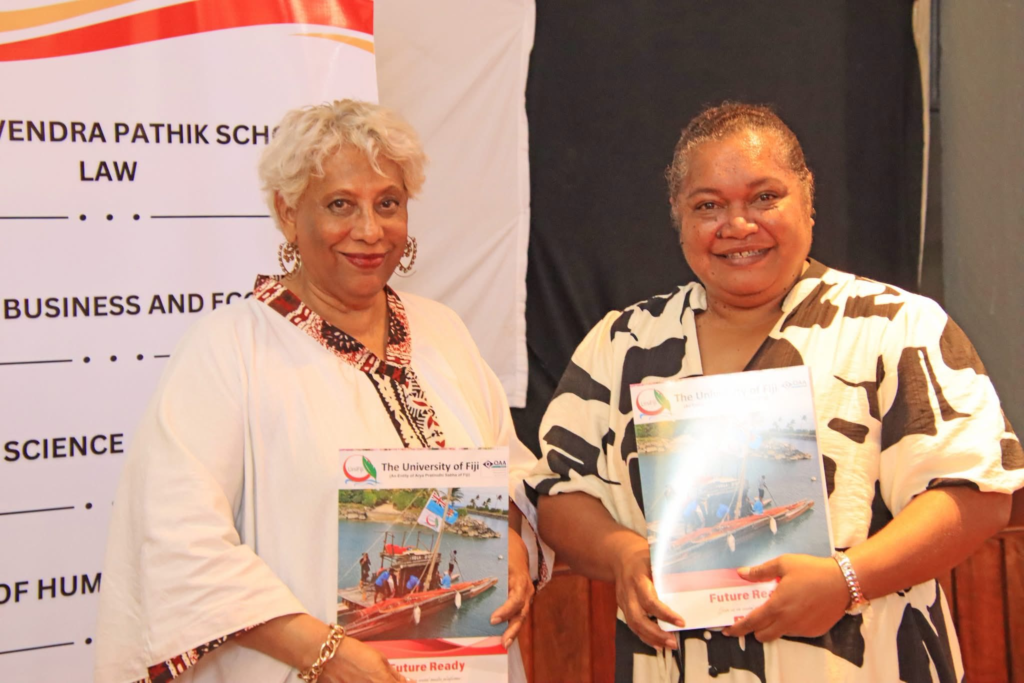
The two organisations signed a Memorandum of Understanding (MOU) on Friday, 28 August, establishing a three-year framework for collaboration between the FMA and UniFiji’s Journalism and Media Studies (JMS) Programme.
The partnership will provide JMS students with opportunities for industry placements, internships, attachments, mentorship, workshops and direct engagement with working media professionals.
It will also support collaboration on public forums, media literacy initiatives, ethical journalism programmes and other activities aimed at strengthening links between journalism education and the media industry.
UniFiji Vice-Chancellor Professor Shaista Shameem said the agreement represented an important milestone for the University and would take the JMS Programme into a new phase of direct engagement with Fiji’s mainstream media.
“The MOU will open doors for our aspiring and serving journalists to excel, network, and keep up with emerging trends,” Professor Shameem said.
She said the JMS Programme had grown considerably from its beginnings with three students at the Saweni Campus, with its graduates now working within Fiji’s mainstream media industry.
Professor Shameem, herself a former journalist with The Fiji Times, said the partnership reflected UniFiji’s Future Ready approach, particularly as journalism and communications continue to change in response to emerging technologies.
The JMS Programme now extends beyond traditional journalism and includes public relations, web design, coding, film and documentary production, with discussions also taking place on how the programme can further evolve to reflect the broader multimedia environment.
Fijian Media Association Communications Coordinator Elenoa Masi Baselala welcomed the partnership, saying stronger links between universities and the media industry were increasingly important as news organisations adapt to major changes in technology and the way journalism is practised.
Ms Baselala, a former journalist and former Deputy Editor-in-Chief of The Fiji Times, said structured journalism training had historically played an important role within newsrooms.
She said the industry had undergone significant changes over the years and there was now a need to strengthen some of the core skills associated with journalism, including direct questioning, reporting and writing.
“One of the important reasons for having this training is because of AI. As journalists, we have to think about what the future looks like for us in the media industry as AI develops,” Ms Baselala said.
She said this was particularly important in an environment where journalists were also having to respond to the growing challenges of misinformation and disinformation.
Ms Baselala said the FMA welcomed UniFiji’s commitment to journalism education and regarded the MOU as an opportunity to develop graduates whose training reflected the current needs of the industry.
She also highlighted the FMA’s work in creating spaces for greater public engagement through its Town Hall meetings, which bring members of the public together with national leaders for direct question-and-answer discussions.
The Association has been taking the initiative beyond the Suva area to communities where regular media coverage can sometimes be limited because of the costs associated with travelling and reporting from outside major urban centres.
Ms Baselala said the media industry itself continued to rebuild and adapt following years of operating within a restrictive media environment, while at the same time responding to financial pressures and rapid changes in technology.
She said partnerships such as the one with UniFiji could contribute towards strengthening professional skills and preparing young journalists for the realities of modern newsrooms.
Professor Shameem also highlighted opportunities already emerging through the partnership, including the participation of JMS students in an upcoming gathering of regional media professionals in Savusavu.
She thanked the Fijian Media Association for supporting the University’s efforts to expose students to the profession and acknowledged the Association’s leadership for responding positively to the proposed collaboration.
The agreement complements a number of initiatives already being undertaken through UniFiji’s JMS Programme.
These include the UniFiji Press Club, which provides a platform for discussion on issues of national importance, with students expected to take a greater role in organising future sessions.
The University is also progressing plans for radio announcer training and student on-air programming through its in-house Vox Populi station, which has secured its own FM frequency.
Under the MOU, UniFiji and FMA will also collaborate on initiatives promoting responsible media practice, ethical journalism and media literacy in Fiji and, where mutually agreed, across the wider Pacific.
The agreement will remain in effect for three years.
Public Relations Office

