The University of Fiji is contributing community-level evidence to strengthen understanding of climate displacement, mobility and adaptation across Fiji and the wider Pacific through research undertaken in collaboration with the International Organization for Migration (IOM).
The research is being carried out under an existing Memorandum of Understanding between the University and IOM and brings together expertise from the University’s Department of Science and Centre for iTaukei Studies.
Vice-Chancellor Professor Shaista Shameem said the research would help deepen understanding of climate displacement as a social issue and explore possible responses for populations affected by the climate crisis.
“The international predicament of IDPs, or Internally Displaced Peoples, has recently expanded with the climate crisis. Many populations have been made vulnerable by global warming due to industrial activity in countries that can adopt a duty of care policy to mitigate their effects.
“Our research will throw more light on the climate crisis as a social issue and find possible solutions by considering a variety of options for IDPs,” Professor Shameem said.
The University of Fiji research team is led by Dr Priyatma Singh and includes Ms Nunia Bari from the Department of Science, together with Mr Mosese Baiseisei and Mr Usaia Gaunavou from the Centre for iTaukei Studies.
Through the collaboration, the team has been working with climate-vulnerable communities as part of the Risk Index for Climate Displacement (RICD) initiative.
The RICD is a decision-support initiative developed by IOM’s Climate Mobility Innovation Lab in collaboration with the University of the Philippines Resilience Institute, the Asian Institute of Technology, and a wider network of government, scientific and academic partners.
The UniFiji team has worked across 10 communities in Ba and Macuata provinces to understand how people experience and respond to climate-related risks.
The research examines not only exposure to hazards but also how these pressures interact with livelihoods, infrastructure, land, culture, kinship and access to services to shape decisions about staying, moving temporarily or considering relocation.
The Fiji community and provincial reports have now been completed and are expected to be published through IOM, making the findings available to a wider audience.
Dissemination is already underway, with emerging findings presented at the International Symposium on Climate Change Mitigation and Adaptation Strategies in the Asia-Pacific Region, hosted by the University of Fiji on 27–28 August 2026, and at the Climate Mobility Dialogue in Melbourne on 9–10 September 2026.
The research is now entering its next phase, with the University of Fiji team working with IOM to analyse data from Vanuatu.
This will provide an opportunity to examine climate mobility experiences across different Pacific contexts and identify both shared and context-specific challenges.
Community engagement remains central to the research. Further activities are planned in Fiji and Vanuatu to share and validate findings with participating communities and engage policymakers and other stakeholders, ensuring that community experiences and perspectives are accurately represented and can inform wider discussions on climate mobility and adaptation.
For the University of Fiji team, the project is also building locally grounded expertise in climate mobility research and strengthening the contribution of Pacific researchers and communities to regional and international discussions on climate displacement and adaptation.
The University of Fiji (UOF) has urged Parliament to reconsider key provisions of three electoral reform Bills that would substantially reduce penalties for serious electoral misconduct, permit political parties and candidates to provide voters with free transport and refreshments, introduce new grounds affecting voter registration, and significantly liberalize political donation rules.
The University has made a formal submission on the Electoral (Amendment) Bill 2026 (No. 29), Electoral (Registration of Voters) (Amendment) Bill 2026 (No. 30), and Political Parties (Registration, Conduct, Funding and Disclosures) (Amendment) Bill 2026 (No. 31) to the Standing Committee on Justice, Law and Human Rights.
Vice Chancellor, Professor Shaista Shameem said UOF supports reforms that improve electoral administration, accessibility and accountability, but cautioned against weakening safeguards that protect voters and public confidence in elections.
“Electoral reform must strengthen democracy, not weaken the safeguards that protect it. Where protections against bribery, undue influence and improper political financing are being reduced, there must be a clear and compelling justification,” Professor Shameem said.
Bill 29: Why reduce penalties for serious electoral misconduct?
A central concern raised by UOF is the proposed substantial reduction of penalties for serious electoral offences.
Under Bill 29, serious offences including bribery, undue influence and personation, which currently attract maximum imprisonment terms of up to 10 years, would fall within a new “corrupt electoral practice” framework carrying a maximum of two years’ imprisonment. Other offences that currently carry imprisonment would become fine-only “illegal electoral practices”.
The Bill also allows a political party to be sentenced to imprisonment under section 135A, which is not physically possible, and this should be corrected, the fine tier already provided for political parties ($100,000) should simply apply on its own.
“Bribery, undue influence and personation strike at the integrity of the vote itself. Reducing maximum penalties of up to 10 years to a maximum of two years is a significant policy shift. Parliament and the public should be told clearly why it is necessary,” Professor Shameem said.
UOF has recommended a comprehensive comparison of existing and proposed penalties, together with the policy justification for each reduction or reclassification. Serious electoral misconduct, the University says, must continue to attract effective, proportionate and sufficiently deterrent sanctions.
Free transport and refreshments: where is the line?
Bill 29 would also allow political parties, candidates and their representatives to provide voters with free transport directly to or from the polling venue to which the voter is assigned, and free refreshments during the journey or outside the 100-metre polling boundary, provided they do not influence or attempt to influence the voter’s choice.
UOF recognizes that genuine transport assistance may facilitate participation. However, the law must clearly distinguish voter assistance from treating or electoral inducement.
“Helping someone exercise their right to vote is one thing. Providing benefits in circumstances capable of influencing that vote is another. The law must draw that boundary clearly,” Professor Shameem said.
UOF recommends reasonable limits on the nature and value of refreshments, safeguards against benefits being selectively targeted at identified supporters, and appropriate disclosure or record-keeping requirements.
The University says this amendment should also be considered alongside the proposed reduction in the maximum imprisonment for remaining prohibited vote-buying conduct from 10 years to two years.
“The Bill would expand what parties and candidates may lawfully provide to voters while substantially reducing the maximum penalty when conduct crosses the line into vote buying. Parliament must consider the combined effect, not each amendment in isolation,” Professor Shameem said.
Other Bill 29 concerns include removing the 48-hour pre-poll campaign restriction, meaning the relevant campaign restrictions would apply only on polling day, reducing the restricted area around polling venues from 300 metres to 100 metres, and removing the Supervisor of Elections’ compulsory information-gathering powers without identifying an equivalent replacement. These provisions currently allow the Supervisor to compel any person to disclose relevant information or documents, overriding confidentiality or secrecy obligations under any other law, with penalties for non-compliance or false disclosure. Repealing them, without replacement, would remove both the compulsion mechanism and its enforcement.”
Bill 29 also introduces a new quality-assurance recount power. UOF recognizes the value of quality-assurance recounts in verifying the accuracy of the count and strengthening confidence in results, but says the Bill should clearly define when the power may be used, how it operates alongside the existing recount procedure, and what review or appeal rights apply.
Bill 30: Voter disqualification must be clearly defined by law
Bill 30 would establish a Corrupt Electoral Practices List (CEPL), with inclusion potentially resulting in removal from the National Register of Voters for up to four years.
UOF says that where legislation affects a person’s ability to vote, the grounds, procedures and safeguards should be clearly established in the law itself.
The Bill refers to “Category A” offences under the Electoral (Local Government Elections) Regulations 2026 without identifying those offences in the Bill or establishing the criteria for that classification.
UOF has also recommended that where the conviction or Court finding underlying a CEPL listing is overturned, quashed or set aside, the law should expressly require the person’s prompt removal from the CEPL and reinstatement to the voter roll.
The University has further questioned why breach of official duty by an election registration officer, currently punishable by a maximum fine of $50,000 and/or 10 years’ imprisonment, would become a fine-only offence.
“A consequence as serious as losing voter registration must rest on clear law, clear grounds and proper safeguards,” Professor Shameem said.
Bill 31: Who funds political parties — and when do voters get to know?
UOF has raised significant concerns about the combined effect of the political-finance reforms under Bill 31.
Clause 8 would remove the existing $10,000 annual donation limit, permit donations from persons who are neither Fijian citizens nor former Fijian citizens, and require those donors to declare their donations to the Registrar within 60 days after polling day, with the declaration then published.
This could allow a substantial non-citizen donation to finance an election campaign without voters knowing about it before they vote.
“Voters should know who is substantially financing political parties and candidates before they cast their ballots. Disclosure after polling provides retrospective accountability; it does not give voters the information when they need it most,” Professor Shameem said.
UOF recommends retaining a reasonable donation cap; retaining the restriction on non-citizen donations or, at minimum, imposing strict monetary and source-verification safeguards; and requiring significant donations to be declared and published promptly after receipt and before polling day.
The University has also called for safeguards to verify the true source of political funds and prevent political-finance rules from being circumvented through nominees or intermediaries.
UOF says removing donation limits also sits uneasily with the stated objective of campaign expenditure limits creating a “level playing field”.
“Expenditure limits control how much may be spent. Donation limits address how much financial influence may be concentrated in a single donor. They are different safeguards and serve different purposes,” Professor Shameem said.
UOF supports campaign expenditure limits in principle but says the proposed ceilings of $300,000 per candidate and $3 million per political party should be supported by an evidence-based justification. The final submission identifies the absence of an explained basis for those amounts as one of UOF’s principal concerns.
The University has also addressed proposed provisions concerning protocol or similar gifts to villages and community groups. UOF recognizes and respects the importance of genuine customary protocol in Fiji. However, declaration of a gift should not, by itself, provide a safe harbour from bribery laws where the benefit is intended to induce electoral support. UOF recommends clear definitions, reasonable value limits and appropriate safeguards.
Timing of the reforms
UOF has also raised concern about the timing of the reforms. Fiji is within the constitutional window for the next General Election, from 7 August 2026 to 6 February 2027, and the campaign period commenced on 25 May 2026.
The University is not calling for all reforms to be postponed. Instead, it recommends a clause-by-clause assessment, with provisions not necessary for the effective administration, accessibility or integrity of the forthcoming election deferred until after the election.
Any provisions applying to the forthcoming election should have clear transitional arrangements. UOF has also stressed that the three Bills are interconnected and their commencement should be coordinated.
Electoral reform must strengthen public confidence
UOF says the Bills contain reforms capable of improving electoral administration, accessibility and accountability. Its concern is that changes which remove or reduce existing safeguards should not proceed without clear reasons, evidence and proportionate protections.
“These reforms concern the protection of the vote, the consequences of electoral wrongdoing, who may finance political campaigns, what voters are entitled to know before polling day, and the circumstances in which a person may lose voter registration. These are matters that go directly to public confidence in the electoral process,” Professor Shameem said.
“Our position is straightforward: make elections more accessible and effective, but do not weaken the safeguards that keep them free, fair, transparent and credible.”
The three Bills should only proceed subject to appropriate amendment and clarification.
Law students at The University of Fiji have drafted and submitted to the Prime Minister a 68-page proposed Constitution for Fiji, setting out the institutions, rights and safeguards they believe should help shape the future their generation will inherit.
The proposed Constitution was drafted collectively over just two weeks by the Constitutional Law 205 Class of 2026 at the Justice Devendra Pathik School of Law as part of an assignment that challenged students to move from studying constitutional law to designing an entire constitutional framework for the country.
The students have also decided to release their proposed Constitution for wider public discussion.
The students’ proposal comes as Fiji is undergoing a wider national constitutional review, with the Constitution Review Commission report scheduled to be tabled in Parliament at a special sitting on 22 September. The LAW 205 document is a separate academic initiative, developed independently by the students as part of their Constitutional Law studies.
Vice-Chancellor Professor Shaista Shameem, lecturer in Constitutional Law 205, said the exercise required students to move beyond studying constitutional principles and engage directly with the difficult choices involved in constitution-making.
“I said to the students at the beginning of the semester that I had made submissions to the Constitutional Review Commission that we did not need a Constitution for Fiji because all our constitutions had brought nothing but instability. I then challenged the Law 205 students to draft a Constitution that would make me change my mind, and they did. They did this collectively through reference to all Fiji’s Constitutions since the 1860s to 2013. It’s a brilliant document and now they are seeking endorsement from the body politic to consider it seriously. I am very proud of them,” Professor Shameem said.
In their message accompanying the proposed Constitution to the Prime Minister, the students said their class represented a demographic that would play an important role in Fiji’s future and that the class itself reflected the broader national demographic.
They said this made it important for the perspectives and preferences of their generation to form part of discussions about Fiji’s constitutional future.
The students also expressed their willingness to have their proposals discussed publicly, leading to their decision to release the document for wider public consideration after respectfully presenting it to the Head of Government.
The proposed Constitution brings together the students’ ideas on how public power should be exercised, how institutions should be structured, how rights should be protected and how governments and public officials should remain accountable to the people.
The document describes itself as a complete proposed constitutional framework, guided by principles including popular sovereignty, democratic governance, constitutional supremacy, the rule of law, separation of powers, independent courts and institutions, accountable public administration, protection of rights and communities, and the peaceful transfer of political power.
Among the proposals is a bicameral Parliament comprising a House of Representatives and a Senate. The proposed House would consist of 71 members, combining geographical constituency representation with proportional representation, while the Senate would provide additional legislative scrutiny and representation for communities and groups that may otherwise be under-represented.
The proposed framework also places significant emphasis on accountability and on the principle that public power must be exercised for the benefit of the people. Its opening provisions state that sovereignty belongs to the people of Fiji and that public office is a public trust.
The students also addressed emerging issues that are increasingly becoming part of constitutional and governance discussions, including personal data protection, internet access, cybercrime, artificial intelligence and automated decision-making.
Under the proposed framework, a person whose important rights or interests are significantly affected by an automated decision could, where appropriate, know that artificial intelligence was materially used, receive an understandable explanation, request human review and challenge an unlawful or discriminatory decision.
The draft also recognises a right to reasonable and affordable access to the internet and calls for reliable and accessible internet services to be progressively promoted throughout Fiji, particularly for rural, maritime and underserved communities.
Environmental protection and the interests of future generations also feature prominently in the students’ work. The proposed Constitution provides for a right to a clean, healthy and sustainable environment and requires the State to take reasonable account of the long-term interests and rights of future generations when making decisions concerning the environment, natural resources, technology, artificial intelligence, public finance and national development.
The document covers constitutional principles, the Bill of Rights, Parliament, the Executive, Judiciary, State and disciplined services, finance and public expenditure, accountability, emergency powers, constitutional accountability, amendment procedures and transitional provisions.
One of the distinctive features of the student-drafted Constitution is its attempt to respond not only to Fiji’s constitutional experience, but also to issues that could increasingly shape governance in the decades ahead.
Alongside the traditional institutions and protections expected in a Constitution, the students have brought digital rights, artificial intelligence, cybersecurity, environmental sustainability and the interests of future generations directly into their proposed constitutional framework.
In doing so, the Constitutional Law 205 Class has produced more than an academic assignment. It is a collective statement by a new generation of law students about the institutions, protections and responsibilities they believe deserve consideration as Fiji thinks about its constitutional future.
The proposed Constitution remains an academic work developed by the Constitutional Law 205 Class of 2026 and is separate from any official Government constitutional drafting process.
To access the constitution, follow the link:
https://drive.google.com/drive/folders/1MpajNUqNuX7JzOPW0wCJxpS8R3jhaAtc?usp=sharing
The University of Fiji has strengthened its international research engagement by contributing Pacific and Small Island Developing States perspectives to discussions on the future of global energy access, climate research and equitable academic partnerships at the University of Oxford.
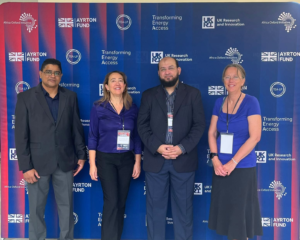
Dr Ramendra Prasad, Associate Professor and Head of Science in the School of Science and Technology, represented UniFiji at the Africa Oxford Initiative and Transforming Energy Access Academic Symposium 2026, held at the University of Oxford in the United Kingdom on 7–8 September. He attended in his capacity as UniFiji Project Lead for the Transforming Energy Access–Learning Partnership project.
Vice-Chancellor Professor Shaista Shameem said the University’s participation reflected the importance of ensuring Pacific institutions are part of international conversations on energy transition, climate action and research collaboration.
“It is very satisfying to see that senior academics of the University are invited to provide insights at prestigious universities abroad especially in research methodologies and SIDS priorities. We expect that our unique experiences will add value to international conversations and roundtables such as these and create impact where it’s needed most.”
The two-day symposium brought together more than 150 academics, practitioners and innovators from the United Kingdom and the Global South to help shape future research and academic partnerships in energy and climate. The programme placed particular emphasis on equitable Global South–North collaboration and ensuring that future research priorities reflect the needs of Global South institutions, communities and energy systems.
The symposium was supported by UK Aid, the Africa Oxford Initiative, the Carbon Trust, the Transforming Energy Access–Learning Partnership and UK Research and Innovation.
Rather than being limited to presentations, the programme was built around facilitated discussions and collaborative sessions. Participants examined the principles of effective and mutually beneficial research partnerships, what should be built, funded or connected next in energy access, and how international research collaborations can move from discussion to implementation.
Dr Prasad participated throughout the two-day programme, contributing perspectives from Fiji, the Pacific and Small Island Developing States to discussions on energy access, research priorities, partnership models and future collaboration.
For UniFiji’s School of Science and Technology, the engagement is closely linked to research and teaching in renewable energy, climate change, environmental science, data-driven modelling and sustainable development. The symposium also provided a framework for connecting scientific research more directly with policy, innovation, implementation and skills development.
The engagement has also created opportunities for UniFiji to strengthen relationships with universities, research networks, practitioners and international organisations, while exploring possible joint research, postgraduate supervision, academic exchanges and future research and funding collaborations.
The University’s participation supports its wider efforts to contribute locally grounded Pacific knowledge to international energy and climate-transition discussions and to strengthen research capability that responds to the needs of Fiji and other Small Island Developing States.