The University of Fiji’s participation at the starting line of the Vuda Marina to Cape Town leg of the global small boats race on Saturday was symbolic of shared endurance despite all odds.
The University of Fiji was asked to blow the conch shell to start off the Mini Globe Race from the University’s Drua, the I Vola Sigavou, on Saturday.
Vice Chancellor Professor Shaista Shameem said staff and students formally restarted the global race of small boats on its second leg between Fiji and Cape Town. The small boats, each with a single skipper and no other crew, are continuing the race from Fiji over the top of Australia, then through the Indian Ocean to the treacherous Southern Ocean to complete the third part of the race. After Cape Town the boats will travel to their final destination, Portugal from where the race started in December 2024.
Professor Shameem said that when Adam Wade of Vuda Marina requested UniFiji to restart the race from the marina to Cape Town by blowing the conch shell from the I Vola Sigavou, they did not hesitate. On UniFiji’s part, their participation was an appreciation of the endurance of the sailors who had only an abundance of sheer grit to enable them to survive. It resonated with UniFiji’s own experience of running a University with nothing but the sniff of an oily rag, as the saying goes, she said.
Don McIntyre, the Founder and Chair of Ocean Frontiers Pty Ltd which is the company behind the race, expressed his appreciation on behalf of the Mini Boat skippers for the University’s participation to restart the race from the Drua. A group of the University’s staff and students sailed on the I Vola Sigavou to the starting line just outside the Vuda Marina lagoon where Centre for i-Taukei Studies student, Anare Ramanakiwai, in full warrior costume blew the conch to start the race off.
McIntyre said the motivation behind the Mini Globe Race was to invite the owners of small boats to have an adventure. The skippers all built their own small boats from plywood in their backyards, designing them specifically to sail round the world so they are safe and strong, he said. The skippers come from all over the world and their aim is to circumnavigate earth in their small boats. The boats do not have engines, just angles.
Two of the 15 skippers are women, Pilar Pasanau from Catalonia in Spain and Jasmine Harrison of the UK. Jasmine Harrison holds the 2021 world record for becoming the youngest solo female to row across the Atlantic at the age of 21 and the first female to swim the full length of the British Isles from top to bottom in 2022. She became a sailor only in 2023, and said that sailing around the world in a small boat was her toughest endurance challenge so far. “The leg from Tonga to Fiji almost broke me with no wind for days and then huge waves crashing over the boat in the middle of the night” she said.
Pilar Pasanau said her experience of the third leg was the biggest challenge but her experience of sailing the Atlantic several times solo took her through. Landfall in Fiji with the warmth of the people and place had rejuvenated her, she said. This was the sentiment expressed by all the skippers as they prepared to leave again for another arduous 10,000 nautical mile trip into the Southern Ocean, across to Cape Town.
The General Manager of Vuda Marina, Adam Wade said that the University’s involvement in the race restart was a powerful way of highlighting Fiji’s sailing heritage. In the past the drua was the main form of transport and the skippers of the small boats in the race were delighted to have the University’s presence at the race.
“It is important that that the drua tradition is revived and recognized as well, because the older crafts will go a lot faster than modern ones.
Wade also highlighted Vuda Marina’s long-running sailing education programmes.“We’ve been teaching kids how to sail for 12 years now, and we teach anywhere between 200 to 400 kids a year,” he said. “It’s amazing how many of them are naturals. They can figure out wind angles and how to make the boat go in a certain direction.
Reflecting on the broader significance of the Mini Globe Race, Wade said the most important thing to him was that the skippers are home boatbuilders. You don’t have to be in a multi-million-
dollar boat. You can do this in something you created yourself.”
Wade was also recently named an honorary member of the Mini Globe Racers. On what the race means for Fiji’s visibility on the global sailing map he said that the attention had earned a lot for similar challenges in the future. “I definitely hope this opens more possibilities. Fiji is just geographically located in a great part of the world. When people are doing a circumnavigation of the Earth, the trade winds are going to push you to Fiji eventually. You can get repairs done, provision, have your friends and family come visit, and have a holiday. It’s a good thing for Fiji.”
Speaking on the eve of the restart, Professor Shameem said that the University was able not only to meet intrepid and very brave skippers and sailors but also to take part in a very emotional farewell of the boats as they continued on their journey across the world. The Drua itself had a proud seafaring origin and so to be able to participate in the momentous race at the beginning was an honour for the University.
The University of Fiji’s Comprehensive Strategy of Chess Education in Fiji (Chess in UNIFIJI) is gaining the reputation of promoting good chess globally and has now reached strategic cooperation with other countries in education enhancement as well as Fijians in these countries.
The program supports student learning, encourages thinking skills, and has even been praised by world-famous chess champion Garry Kasparov.
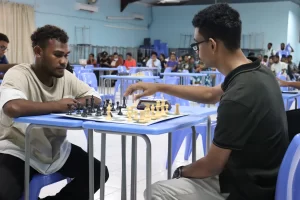
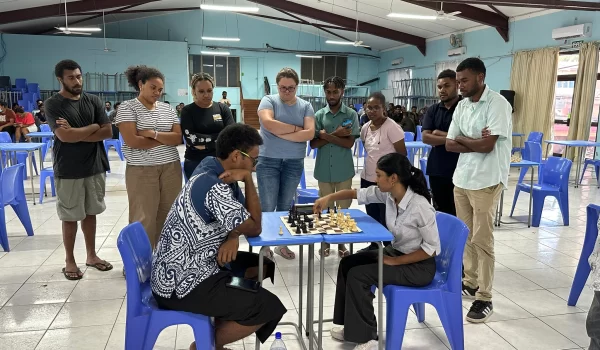
To celebrate World Chess Day, the University held its first-ever Student Blitz Chess Competition on Friday, July 18, 2025. The event took place at the University’s Main Hall and included 14 players who competed in seven fast-paced rounds.
Vice-Chancellor Professor Shaista Shameem said the event was a great way to mark World Chess Day and showed how UniFiji is using games like chess to help students think better and learn more.
“The University’s international chess profile has grown from strength to strength ever since it was first offered as a stress-buster during the Covid lockdowns when students of the University were encouraged to play chess online”.
She said that the game of chess was supported fully at the University due to its value in strategic thinking, mental dexterity and building the competitive spirit required for intellectual innovation and systemic development.
“Students who play chess do very well in their studies, and the University sees chess as a value-added learning tool”, she said.
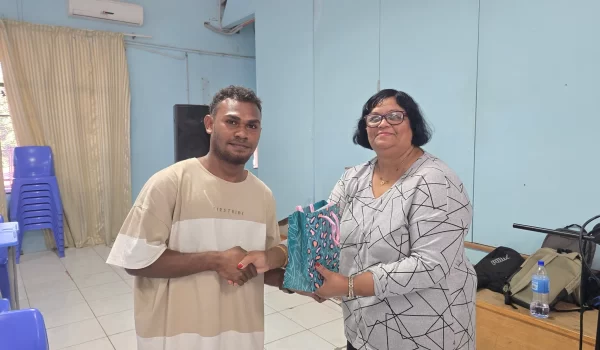
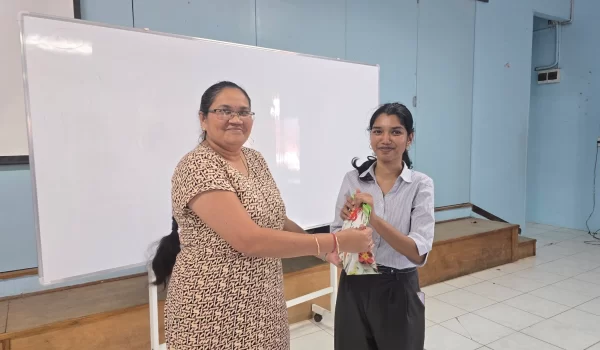
Chief Arbiter Ricardo Gregorio C. Corpuz III ran the competition and said that this was a big moment for UniFiji as this is the first of many tournaments for the university.
“It started from here, then we will be having more tournaments. This will invite new players and students to play chess.”
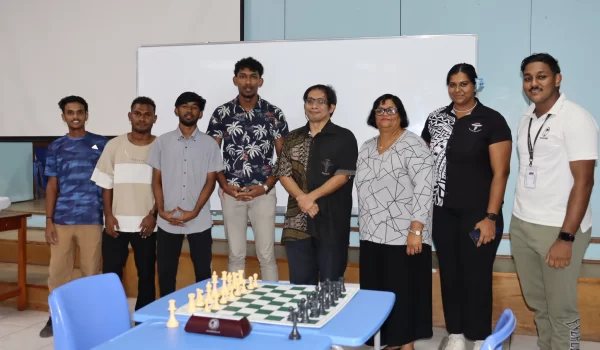
Winners of the day were:
– Men’s Champion: Erick Auto (MBBS 1)
– Women’s Champion: Avani Lingam (MBBS 2)
The Chess in UniFiji program is growing. It now includes games between staff, tournaments for primary and secondary school students, and even international online events. In partnership with the Fiji Chess Federation, the university is helping young people learn new skills through chess while building a strong image for UniFiji in the Western Division.
UniFiji students also joined an international online chess competition through Lichess, where they played with students from other countries. This showed UniFiji’s commitment to new ideas and global learning.
During his speech at the 2025 Kasparov Chess Foundation University Cup, Garry Kasparov said that UniFiji was “leading the way in using chess to foster strategic literacy and intergenerational learning.”
With more tournaments and outreach events planned, UniFiji is committed to helping students become smart thinkers, disciplined learners, and future leaders one move at a time.
The University of Fiji’s Review of the Education Act 1966- Aspirational to Action, Transforming Education through Legislative Reform: Submissions to the Law Reform Commission and the Ministry of Education.
The University of Fiji is pleased to announce the completion of its comprehensive review of the Education Act 1966. The final submission was made to the Fiji Reform Commission and the Ministry of Education today.
In its submissions the University of Fiji Vice Chancellor Professor Shaista Shameem thanked the Ministry of Education and Fiji Law Reform Commission for initiating the review and prioritizing the future education in Fiji.
“As a significant higher education institution, with campuses in Saweni, Ba and Samabula, and an office in Levuka, the University hopes that its recommendations, reached after a significant period of consultations with its stakeholders, will be helpful to the Ministry as it moves towards enacting a 21st century modern educational service for the development of the nation, especially focused on young people”, she said.
The submission aligns Fiji’s international commitments to the right to education as well as to the 2013 Constitution and national development goals. The submission recommends adopting a policy so that no child is excluded or left behind due to a flawed or ineffective system. The University said that all children deserved an education system that empowers, protects, supports and uplifts and are not hampered by system failures or outmoded legislation.
Professor Shameem said that the authorities needed to ensure that the Education Ministry was properly resourced to provide a holistic and human values-based education for Fiji’s young people as they were the future of the nation.
Significant recommendations from UniFiji include:
a) Compulsory Schooling from age 5 – 18 or year 12/13 equivalent.
• Mandate compulsory schooling from age 5 until completion of Year 12 or 18 years, whichever comes first;
• Impose a statutory duty on parents and legal guardians to ensure that their children are enrolled in school and regularly attend classes;
• Include all geographical areas of Fiji under compulsory free education, without exclusions.
b) National Curriculum- Mandate a robust and relevant national curriculum and ensure that key learning areas, starting from primary schools, are prescribed and that the curriculum is age appropriate, inclusive, culturally sensitive and responsive, and have integrated critical thinking, digital literacy, financial literacy, climate education, civic responsibilities and basic legal education. The national curriculum must be monitored regularly and reviewed every 2 years by an independent and permanent Education Commission established for the purpose.
c) Truancy Prevention & Enforcement- Ministry to appoint & empower “Attendance Watch Officers” to actively monitor public spaces during school hours daily to identify school age children who are not in class without lawful reason and escort them back to school or home. This will also significantly reduce drug & sexual related offences involving children and young people in Fiji, which is a growing concern. Work closely with schools and legal guardians to ensure the children are closely monitored throughout the hours of school.
d) Integration of Education Act 1966 & Higher Education Act 2008- proposed to be replaced by a single combined overall legislation, “Education Act”. This overall legislation should cover the entire education system of Fiji from Early Childhood to Tertiary. Also, re-designate the Higher Education Commission as a dedicated Department under the Ministry of Education with appropriately qualified and experienced educators at all levels. This will ensure that there is proper governance, policy consistency, oversight and legal alignment across all levels of education in Fiji.
e) Health, Safety & Well-being – Place a legal obligation on schools to provide a safe and supportive learning environment, mental & wellbeing support (including access to free trained counsellors or psychologists in each school), and an emergency preparedness unit. Also mandate provision of free school meals (breakfast and/or lunch) to ensure all children have access to at least one nutritious meal a day.
f) School Retention & Performance- Mandate early intervention and catch-up programs to identify and support students at risk, improve performance and reduce drop-out rates through early tailored learning & support programmes.
g) Teacher Quality & Development- review standards for teacher qualifications, registration performance development and evaluation. Re-introduce school inspectors.
h) Governance & Accountability- Strengthen governance and accountability provisions in the Education Act (including management of schools). The Act must clearly outline a clear reporting and decision-making structure to ensure accountability and operational efficiency and to create a more responsive, accountable, adaptive, impactful, effective and transparent education system in Fiji
i) Rights-based Approach to education- ensure that children’s best interests and right to education are the heart of the new education system. Ensure alignment with constitutional guarantees, international obligations of Fiji and dignity, inclusion and equity as core principles;
j) Attendance Management- Introduce a framework to actively monitor student absenteeism, with mandatory thresholds (e.g. 5–10 consecutive days or excessive absences) that trigger early intervention, parental engagement, referrals to the Ministry and compulsory school attendance responses.
k) Discipline in Schools- Empower the Minister to issue guidelines for fair discipline codes to enhance classroom conduct with fewer disruptions, and promote a respectful learning environment which is crucial for student success. Implement reasonable disciplinary measures which allow students to learn from mistakes.
l) Establish an Independent Authority to evaluate legislative effectiveness- responsible for systematically collecting, analyzing and reporting data on identified key performance indicators such as access, equity, student learning outcomes, absenteeism, infrastructure, teacher effectiveness, retention rates, implementation and impact of prevention and intervention programs, to suggest future reforms, budget planning, resource management and stakeholder accountability. Reports should be made publicity available for transparency and public confidence. The proposed standing Education Commission can be the independent authority.
m) School inspections- to be carried out annually to ensure compliance with safety, health, infrastructure and requirements of the Act. If breaches are identified, to take appropriate enforcement action and impose penalties.
n) Inclusive Education- ensure that every child differently-abled child or with learning/special needs has access to quality education through mainstreaming or designated special schools, based on the individual’s needs after consultation with parents/legal guardians.
o) Offences & Penalties- Clearly outline and prescribe offences under the Act, including but not limited to, parents or legal guardians’ failure to enroll and ensure attendance, operating unregistered schools, vesting of qualified school management, obstruction of authorized officers, failure to comply with corrective plan (post inspections), failure to comply with requirements for student health, safety and well-being or any other breaches under the Act. Prescribe appropriate penalties, such as fines, prosecution, suspension of licences etc which should be proportionate to the nature and severity of each offence.
Professor Shaista Shameem said that the University’s comprehensive review of the education sector had identified critical shortcomings and gaps in the current Education Act. This is due to the evolving needs of Fiji’s future including in leadership, educators and society as a whole. She said that the current legislation no longer reflects the realities of our classroom, rights of our children and ambitions of our nation.
The legislative gaps are not minor- they are systemic which require a transformative reform.
The University’s submissions do not proposed merely a legal update but a bold and necessary re-alignment of Fiji’s education system with the needs of every Fijian learner, modern expectations and Fiji’s international obligations. Each recommendation, from mandating compulsory education, early intervention models, annual school inspections, emergency protocols to embedding mental health & wellbeing, nutrition, sanitation, infrastructure, is aimed to build a system that protects, empowers and supports young people from the age of 5 years to tertiary.
It represents a national investment in Fiji’s future to build a resilient, inclusive, future-ready, knowledge-based, adaptive, rights-based, sustainable quality-focused and learner centered education system. Every child deserves more than access to education, they deserve a system that protects and works for them, Professor Shameem said.
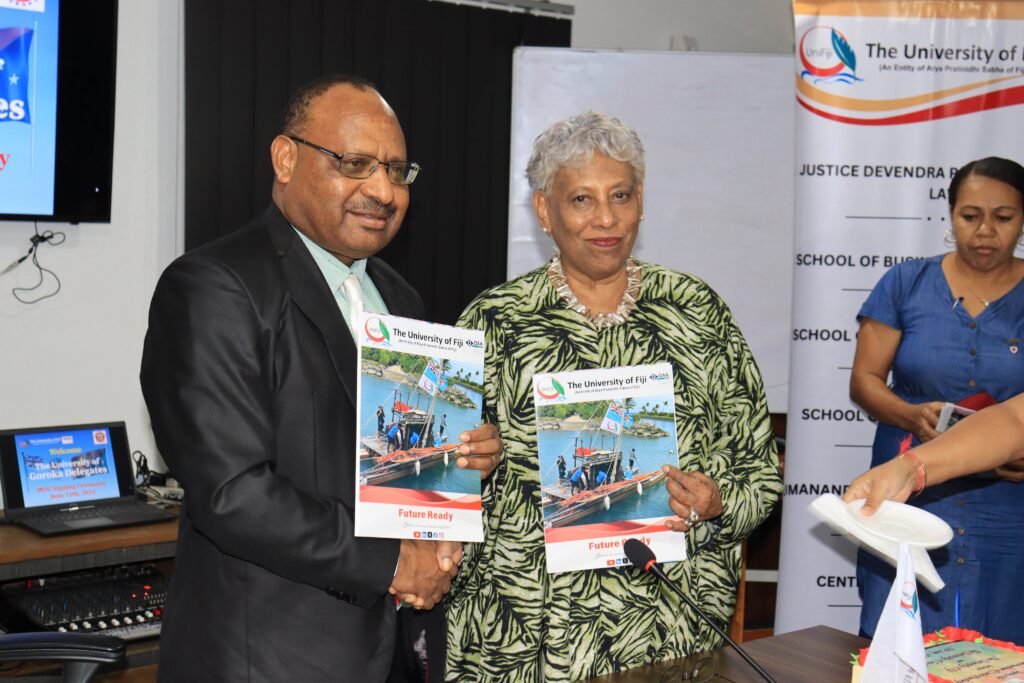
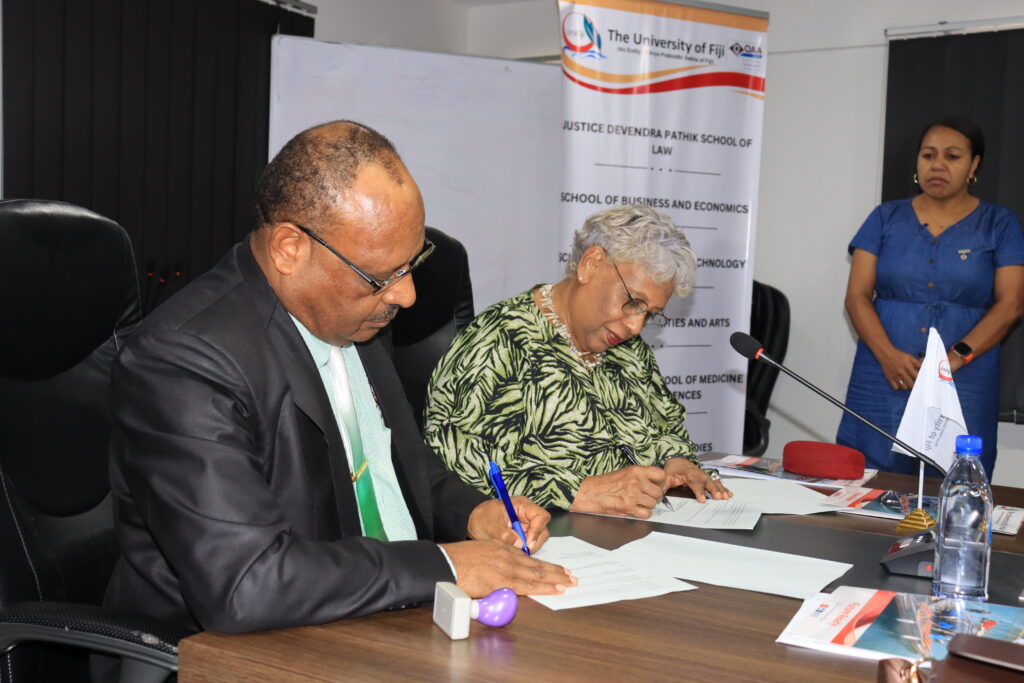
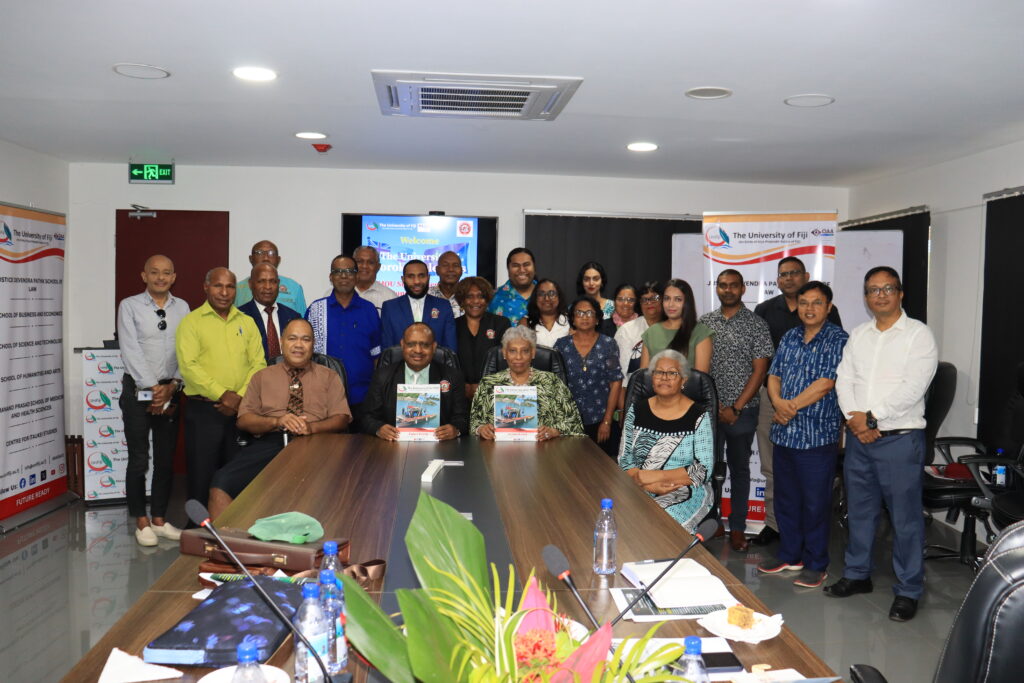
In a significant step towards regional integration and academic collaboration, the University of Fiji and the University of Goroka (Papua New Guinea) have signed a landmark Memorandum of Understanding (MoU) today at a special ceremony held at the University of Fiji’s Saweni campus.
The agreement establishes a formal framework for joint academic initiatives, research collaborations, staff and student exchanges, and the shared promotion of indigenous knowledge, Pacific culture, and inclusive education.
The partnership is set to span three years, with both institutions committing to long-term cooperation and mutual development.
Speaking at the signing ceremony, University of Fiji Vice-Chancellor Professor Shaista Shameem emphasized that the partnership went far beyond formalities.
“This is more than a ceremonial signing. It is a mutual pledge to collaborate, share knowledge, foster innovation, and empower the next generation of scholars and leaders across the Pacific,” she said.
“Yumi one people, yumi one solwara, yumi wan Pacific, we are one people, one ocean, and one Pacific family.”
The MoU outlines areas of collaboration including:
Student and faculty mobility programs
Joint research, conferences, and symposia
Development of joint academic programs and curricula
Shared promotion of indigenous education and Pacific arts, crafts, and music
Support for underserved and rural student populations
Speaking on behalf of the University of Goroka, Vice-Chancellor Dr. Teng Komhiol Waninga described the occasion as “history in the making” and a long-overdue move to strengthen regional higher education ties.
“This MoU is the start of our long journey together as academics, as Melanesian brothers and sisters, and as people working to improve the lives of our communities,” he said.
“Our dolphins, our whales, our tuna, our birds, they know no borders. Neither should we. This is not just an agreement; it is a marriage of shared vision and enduring commitment.”
Dr. Waninga also highlighted the University of Goroka’s role as Papua New Guinea’s leading teacher training institution and noted areas of synergy in teacher education, curriculum development, and Melanesian studies. He extended an open invitation for further exchanges and visits between the two universities.
Both universities share a strong commitment to educational equity, community upliftment, and the preservation of traditional knowledge systems a commitment that this MoU aims to enhance.
The signing ceremony marks the beginning of a shared academic journey between two Pacific universities rooted in a vision of collaboration, resilience, and unity.