University of Fiji Marks World Environment Day with Renewed Commitment to Beating Plastic Pollution

The University of Fiji has joined the global community in commemorating World Environment Day today, June 5, reinforcing its commitment to environmental protection and sustainability.

This year’s theme, “Beat Plastic Pollution,” echoes strongly with the University’s ongoing initiatives to address the rising environmental threat posed by plastic waste.

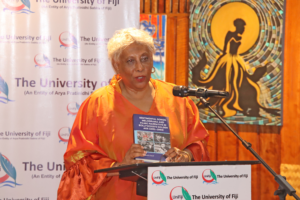
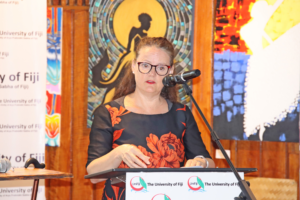
Vice-Chancellor of the University of Fiji, Professor Shaista Shameem stated that as a higher education institution deeply rooted in the Pacific, the University recognizes the environmental vulnerability of island nations like Fiji.

She emphasized that plastic waste continues to increase across land and sea, degrading ecosystems and threatening biodiversity, and in line with UniFiji’s Strategic Plan (2022–2026), the University is committed to advancing environmental consciousness through education, partnerships, and policy advocacy.

Professor Shameem urged the University Community to think about their plastic use in keeping with the theme for World Environment Day 2025.

“It is impossible for us to think about life without plastic, but we have to, if we want the world to address plastic waste seriously” she said.

“Otherwise there are vast islands of plastic waste floating in the ocean, trapping marine life, poisoning our seas and causing havoc to our food sources”.

She further highlighted that the University has established the Ecological and Climate Crises Legal Institute (ECCLI), a pioneering interdisciplinary body that brings together scientific knowledge and legal tools to advocate for long-term environmental resilience.

ECCLI represents UniFiji’s vision of a future-ready academic platform that educates and equips the next generation of Pacific leaders.

Another key initiative implemented by the University is its partnership with the Pacific Recycling Foundation, which supports the collection of recyclables from both Saweni and Samabula Campuses.

The collaboration is an important step towards cultivating a cleaner and healthier learning environment while encouraging responsible behavior among students and staff.

She stated that this partnership with the Pacific Recycling Foundation helps contribute meaningfully to the economy and reduce our environmental footprint.

Professor Shameem said that while many companies undertook to recycle plastic waste, the reality was that there was very little proof that recycling was happening to the extent needed.

She urged staff and students of the University to avoid buying water in plastic bottles unless they could see the evidence of recycling.

The University was looking into ways to eliminate plastics from its campuses if it could, she said.

On and international level, support is growing for the proposed Global Plastic Pollution Treaty, currently being negotiated by the United Nations and backed by more than 200 countries.

The University of Fiji stands in support of such international efforts and pledges to align its local actions with global sustainability goals.

Public Relations Office

Loading

UNIVERSITY OF FIJI IGNITES SCHOLARLY PASSION AT PhD GRADUATE AFTERNOON COFFEE SEMINAR

In a remarkable celebration of academic excellence, the University of Fiji at Saweni Campus hosted a transformative Afternoon Coffee Seminar for PhD and Master’s scholars on Wednesday, 28th May 2025. The Main Hall buzzed with intellectual energy as PhD scholars gathered to draw inspiration and gain valuable insights from distinguished academics and experienced researchers.

Vice Chancellor Professor Shaista Shameem set an inspiring tone, illuminating the path of scholarly inquiry through powerful “why” and “how” questions. Her passionate advocacy for rigorous literature reviews and the profound value of doctoral qualifications resonated deeply with attendees, reinforcing the University’s unwavering commitment to nurturing tomorrow’s thought leaders.

Professor Kishor Meher, Chair of the Post Graduate Committee, captivated the audience with his compelling address on “The Journey to Completion.” He highlighted that this seminar marks the beginning of continuous learning through conducting research seminars with experts. His visionary strategies for navigating research challenges—from structured flexibility to building vibrant research communities—offered a beacon of hope to scholars at every stage. He proudly showcased the University’s cutting-edge research infrastructure, including ProQuest and Wiley databases, and training on referencing managers for speeding up literature review—empowering students to reach new heights of academic achievement.

Distinguished guest Professor Gokulananda Patel from Birla Institute of Management Technology (BIMTECH), India, delivered a thought-provoking presentation on advisor selection, emphasizing this pivotal relationship as a cornerstone of research success. The seminar gained further depth through powerful testimonials from fellow PhD scholars at various stages and a dynamic question-and-answer session where researchers addressed practical challenges: Dr. Amar Singh on data integrity, Mohammed Riaz Azam on overcoming research obstacles, and Sheik Tanzil on the transformative power of mentorship.

As Master of Ceremony, Mohammed Riaz Azam concluded with heartfelt appreciation to the organizers, Registrar’s office, Facilities, IT, and other departments for their seamless support. Attendees continued vibrant discussions over refreshments, with this landmark event kindling a renewed passion for scholarly pursuit at the University of Fiji.

Loading

The University of Fiji acknowledges Ratu Sukuna Day, and honours his legacy of visionary leadership as a lesson to all

The University of Fiji joins the nation in commemorating Ratu Sir Lala Sukuna Day, acknowledging the enduring contributions of one of Fiji’s most distinguished national figures mainly as a legacy for future leaders.

In a statement marking the day, University of Fiji Vice-Chancellor Professor Shaista Shameem reflected on Ratu Sir Lala Sukuna’s lifelong dedication to public service and duty.

“There are some important lessons to be learnt from the legacy of Ratu Sir Lala Sukuna, the most important of which, for present and future leadership, is selfless duty in the service of others”, she said.

Professor Shameem said that Ratu Sukuna was multi-skilled, with achievements that spanned across education, law, governance, and military service, including becoming the first iTaukei university graduate, serving in World War I despite the obstacles he faced, and, later, shaping governance and bureaucracy in colonial Fiji. She said Ratu Sukuna was a thinker who was both charismatic and humble.

She said it was undoubtedly his youthful experiences in Fiji that had shaped Ratu Sukuna which allowed him to find opportunities despite the hardships he faced during his overseas sojourns, including discrimination and impoverishment, judging by the articulate letters he wrote home.

The University of Fiji recognized the human values attributes of Ratu Sir Lala Sukuna which resonates with the University’s own philosophy of education even now, despite the passage of time, Professor Shameem said.

She said the significance of Ratu Sukuna Day was a reminder to the University staff and students of the value of honest leadership in national life.


Loading

University of Fiji and Sri Sathya Sai Global Council Fiji Sign MoU to Strengthen Medical Education and Community Health Services

The University of Fiji and the Sri Sathya Sai Global Council Fiji Pte Ltd (SSSGC) have signed a Memorandum of Understanding (MoU) to enhance medical education and strengthen community health initiatives across Fiji and the Pacific.
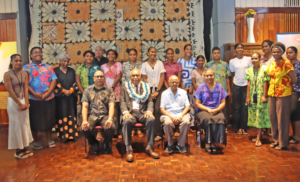
The agreement, signed during the University’s International Health Conference, cements a growing partnership between academia and service that has already seen more than 17 University of Fiji students participate in SSSGC’s outreach programmes.

It now sets a formal framework for broader cooperation from clinical placements abroad to free medical camps at home. The MoU outlines a practical and values-based collaboration designed to empower the next generation of healthcare professionals through service and exposure to global best practices.

Under the agreement, SSSGC will support University of Fiji medical students and staff through:

  • Annual scholarships for final-year MBBS students to undertake immersive clinical training in Australia, New Zealand, or other internationally recognised centres of excellence.
  • Participation in SSSGC’s Annual Free Medical Clinics across Fiji, offering real-world medical experience in underserved communities.
  • Professional development webinars and seminars, both online and in-person, led by internationally respected healthcare professionals.
  • Tailored project-based collaborations designed to meet Fiji’s evolving healthcare priorities through joint planning and resource sharing.

Vice-Chancellor of the University of Fiji, Professor Shaista Shameem, described the MoU as more than a policy instrument but a platform for shared purpose.

“We are pleased to be finalizing the Memorandum of Understanding to further deepen our collaboration, opening new avenues for joint projects, community outreach, and shared growth.  This partnership reflects our commitment to developing medical professionals who are not only skilled but also driven by service and compassion.”

She added that this partnership is not just about academic opportunities, it’s about instilling a deeper sense of purpose in our students.

“Through hands-on service, they will learn that medicine is not only a science but also an act of compassion.”

“Our students will not only gain international exposure but also return with a greater sense of duty to serve locally. This is how we build healthcare leaders who understand both the technical and human side of medicine.”

Mr. Anil Kumar Amin, National President of SSSGC Fiji, acknowledged the longstanding cooperation that has led to this formal agreement.

“It is an absolute honour to witness the signing of this inaugural collaboration. Our organization is grounded in the values of love and service, and this partnership allows us to nurture the next generation of medical professionals while continuing our humanitarian work across Fiji.”

“By investing in the next generation of doctors and health professionals, we’re investing in the future health of Fiji. These students will one day serve our communities and we are proud to walk this journey with them.”

“This partnership exemplifies our commitment to action. We don’t just believe in healthcare for all we act on it, alongside like-minded institutions such as the University of Fiji.”

Mr. Kamal Naidu, Special Programs Coordinator- Zone 3 countries (Australia, New Zealand & Fiji), based in Sydney, reflected on the long-term vision and impact of the partnership.

“This MoU is not merely a formal agreement, it is a shared commitment to nation-building. From medical camps to clinical placements and professional development, our programs aim to equip students with both knowledge and compassion. Together, we are building a sustainable and inclusive healthcare future for Fiji.”

With this MoU, the University of Fiji will advance its goal of providing value-based, high-quality training for medical and nursing professionals while ensuring that students are exposed to real-world challenges and solutions.

The agreement will remain in effect for an initial term of three years, with annual performance reviews and the option for a two-year extension. It also reflects a deep commitment from both institutions to empowering communities, expanding healthcare access, and shaping a resilient and responsive health workforce for the Pacific.

Loading

University of Fiji Announces Plans for New Master’s in Orthopedics at Launch of Inaugural International Health Conference

The University of Fiji has announced its plans to introduce a Master’s in Orthopedics, as part of its ongoing efforts to expand specialist medical training in the region.

The programme will be launched following necessary approvals from University Senate Committee and Higher Education Commission Fiji (HECF).

The announcement was made by Pro Chancellor Pundit Bhuwan Dutt Arya Ratna during the official opening of the University’s International Health Conference, hosted by the Umanand Prasad School of Medicine and Health Sciences (UPSM).

“This programme is a significant addition to our academic offerings, reaffirming our commitment to addressing the growing demand for specialist care across Fiji and the Pacific,” said Pundit Bhuwan Dutt.

“It reflects our vision to not only train general practitioners, but also develop expertise in critical medical disciplines.”

The proposed Master’s in Orthopaedics will complement UPSM’s current programme offerings, which include the MBBS, Bachelor of Medical and Health Sciences, Bachelor of Nursing, and Bachelor of Public Health.

Since its establishment in 2007, the school has expanded its footprint beyond its main Saweni campus to Samabula and Ba, with graduates now serving in healthcare facilities across the nation.

The announcement was made during the opening ceremony of the International Health Conference, a milestone event for the University of Fiji and the broader Pacific medical community.

Held at the Saweni campus, the conference brings together researchers, academics, clinicians, and public health professionals from Fiji and overseas.

“This conference is a platform for collaboration and innovation,” said Pundit Bhuwan Dutt.

“It opens the doors to deeper research, stronger partnerships, and transformative health interventions that go beyond academic discussion and into real-world application.”

The two-day conference features a diverse programme of plenaries, technical sessions, and panel discussions, addressing both general and specialized areas of healthcare. Topics include health systems resilience, medical technology, regional disease burdens, and community health delivery.

In his keynote address, Pundit Bhuwan Dutt also reminded attendees of the importance of human values in medicine.

“Technical knowledge must be paired with compassion, fairness, and ethics. True healthcare transformation comes when professionals engage both the mind and the heart.”

He urged participants to engage fully and let the outcomes of the conference extend into policy, practice, and long-term partnerships.

The conference also pays tribute to the resilience of health workers across the Pacific, especially in the wake of the COVID-19 pandemic.

The university envisions the event as the first of many international academic gatherings aimed at shaping the future of health in the region.

Loading