
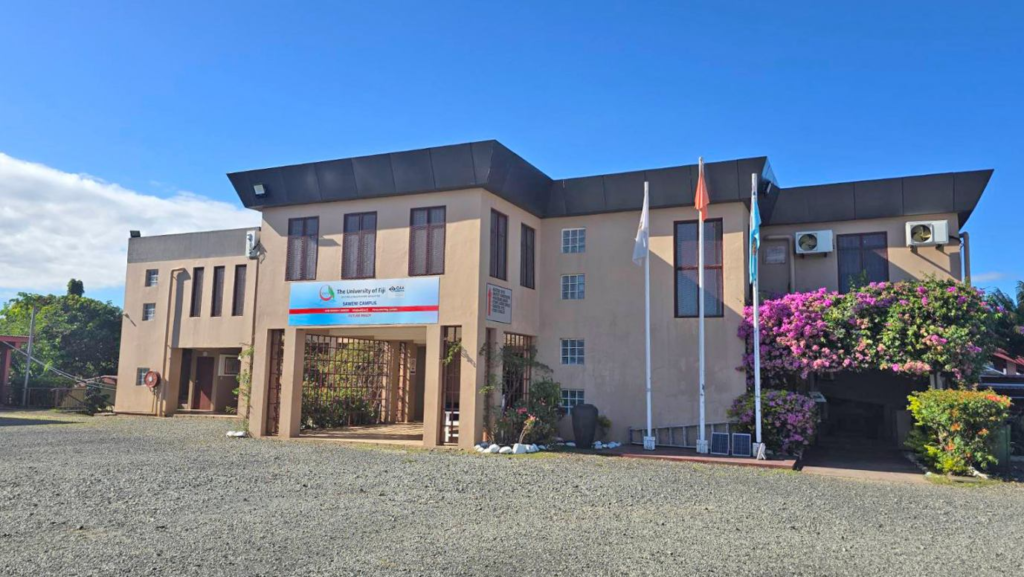
The University of Fiji will host a Tertiary Teaching Symposium for its academic staff as part of its ongoing commitment to strengthening the quality of teaching and learning at the tertiary level.
Vice-Chancellor of the University of Fiji, Professor Shaista Shameem, said the symposium is aimed at strengthening teaching excellence and enhancing the pedagogical capacity of academic staff across the University.
“Tertiary level lecturing is very different from primary or secondary teaching because at university we expect students to spend time on their own work, and self-learn; this is called ‘heutagogy’ or self-directed learning. It allows students, who are usually adults, to investigate their own rhythms of absorbing knowledge. We find heutagogy to be most effective at tertiary level and with the Symposium are giving the opportunity to our academic staff to learn the techniques of university lecturing”.
She said that after a trial run, the University hoped to offer the UniFiji’s tertiary learning programme to other higher education institutions in Fiji and the Pacific.
The symposium will be held on 12 February 2026 for full-time staff, with a separate session scheduled for Saturday, 7 February 2026 for part-time staff. The programme is designed to further develop the teaching skills of lecturers and other teaching staff in line with best practices in tertiary education.
Chair of the University’s Learning and Teaching Committee and Associate Professor of Education, Dr Wahab Ali, said that while academic staff are highly skilled in their respective disciplines and often possess strong research backgrounds, many have had limited formal exposure to teaching at the tertiary level.
“The symposium is intended to equip our teaching staff with heutagogical knowledge and a sound understanding of adult learning principles, enabling them to engage students more effectively in a tertiary education environment,” Dr Ali said.
He noted that tertiary education has become increasingly significant on national and global agendas, particularly as economies transition towards knowledge-driven development.
“There is widespread recognition that high-quality tertiary education is a major driver of economic competitiveness. Countries must raise higher-level employment skills, sustain a globally competitive research base, and improve knowledge dissemination for the benefit of society,” he said.
Dr Ali emphasised the importance of reflective teaching practice in delivering quality tertiary education.
“Excellent teachers are reflective practitioners who are able to evaluate and adapt their teaching approaches to maximise learning opportunities. They demonstrate care, respect, and responsiveness towards learners, and are themselves committed to continuous learning,” he said.
He further highlighted the transformative role of tertiary education in shaping students’ lives.
“Learning at the tertiary level has the potential to influence multiple facets of a student’s life. It is life-changing and empowering, and we hope staff will find the symposium both enlightening and rewarding for themselves and for the students they will be teaching this semester,” Dr Ali added.
The University of Fiji is committed to continuous improvement in teaching quality and to supporting its academic staff in delivering an excellent tertiary learning experience.

