News & Blog

Bema Unveiling

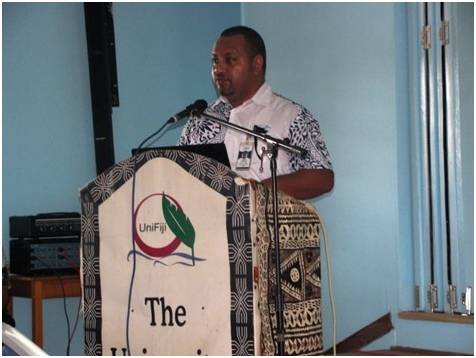
The University Of Fiji’s School Of Law will unveil its ‘Bema’ at the Samabula Campus at a ceremony to be held at the Campus on Friday 3rd February at 4 pm.

Former Fiji High Court Judge and current Commissioner of the Fiji Independent Services Commission (ILSC), Dr Thomas V. Hickie, will officially unveil the Bema.

The Dean of School of Law, Professor Shaista Shameem, said that the Law School’s Bema, which is an Oratory Platform, was constructed in memory of lawyers and public speakers in Ancient Greece who used the platform to express their views and argue their cases before a critical and discerning audience.

‘At the time of Socrates, Plato and Aristotle, the Bema was the central speaking platform where philosophers, lawyers and political figures would argue their philosophical perspectives without referring to notes’. Professor Shameem said that the Ancient Greek speakers expected to be criticised, heckled and argued against, so they had to be prepared to fire back with knowledge of the subject and be witty at the same time.

‘We are training our law students at the University of Fiji to be great orators, whether as lawyers, or parliamentarians, or public speakers on any occasion; the Bema will be our training ground for that’ she said.

Professor Shameem said the Law School was fortunate in that one of the great judicial orators in Fiji, Dr Thomas Hickie, had agreed to unveil the Bema. Dr Hickie was renowned for his public speaking skills and charismatic personality. Professor Shameem expected the legal community and others interested in legal education to attend the Unveiling at the Samabula Campus.


Loading

Massive Market for UniFiji Accounting Graduates

There is an enormous career market for University of Fiji accounting graduates at prestigious organizations says Head of Department, Sandhiya Roy.

The Accounting Department is well positioned to offer accounting courses best suited for industry requirements.

“There are various organizations still calling us for our graduates but most of our students already find employment by the time they complete their courses and before they graduate,” she explained.

She encouraged more students to get enrolled in accounting because the department could very well cater for more than 100 students.

“The student numbers has increased over the years with the past two years having enrolment of 60 students in year 1 but we can cater for more than 100 students. As there is a huge job market for UniFiji accounting graduates, students can see that our curriculum is well versed with relevant accounting standards,” she said,” she said.

She further elaborated that students would have more chances of having a superior learning environment at UniFiji because they have the added advantage of having improved interactions with the lecturers and tutors.

“Since we have a reasonable number, students’ get more time from the lecturers and tutors which enables them to grasp information much easily and this paves a pathway to their successful careers,” she stated.

Registrations are still underway at both the Saweni and Suva Campuses.


Loading

UniFiji LLC Department–Well established to deliver: Chan

echan4

UniFiji’s Language, Literature and Communications (LLC) department is well established to deliver its varied courses with reference to the Fiji Qualifications Framework (FQF) and the University of Fiji Strategic Plan (2017-2021), says

Dr Chan, from The University of New England, NSW Australia, carried out an extensive review of all undergraduate and postgraduate programmes documents and course materials in November, 2016.

“The academic programmes of LLC are well-structured to provide flexible options for students to progress from diploma to degree programs at both undergraduate and postgraduate levels,” she commented.

Dr Chan further added that LLC engages in continuous improvement processes for curriculum development.

“The Quality Assurance Team at UniFiji and academic staff were working together to ensure the relevant FQF learning outcomes and University requirements were met,” she elaborated.

She also shared that the Programme Objectives (PO) explicitly set out the processes and skills students were expected to engage in during the programme of study.

The Head of Department, Kamala Naiker, explained that the findings of Dr. Chan reveal that academic programmes offered in LLC were comprehensively propositioned to prepare graduate teachers for teaching in the local school system.

“The LLC Department always endeavours to see that the teaching, learning and assessment practices of the LLC are of the highest quality, as evidenced by curriculum documents, continuous improvement processes, and overwhelmingly positive student feedbacks,” she reinforced.

The review was conducted as part of the University’s continuous improvement programmes of critical self-examination and to assist with its preparation for accreditation.

Dr. Eveline Chan is a member of the English, Literacies and Languages Education (ELLE) team.

Within this group, she specializes in English and literacy and is a member of the Languages, Literacies and Literature Research Network.

Since the last external review of the department during May 2011, the department has grown in terms of student numbers and further strengthened its programmes structure, content, teaching pedagogy and mode of delivery.


Loading

Two New Courses at the End of PACAM project


DSCN1266

One of the objectives of the Pacific-American Climate Fund (PACAM) project is to introduce two courses under the Environmental Science programme at UniFiji, says the project coordinator Roselyn Naidu.

“We are going to help build those two courses from the knowledge that we have gained from the field and lab. These two courses, Environment Impact Assessment and Geographical Information System would be a part of the Environmental Science programme offered by Department of Science,” she said.

She explained that the commencement of the two courses would act as a build up to achieving their first objective of the project which is to increase local capacity.

“The first objective is to build local capacity to improve the quality, the knowledge, the training towards climate change adaptation and improve scientific knowledge on the effects of climate change to help develop strategies and policies to protect Fiji’s environment. The outcomes of the project will be passed to communities and larger body of knowledge through the students who have taken up these two courses as part of their undergraduate programme,” she said.

She added that the two courses would be introduced towards the end of the project.

The team has been reaching out to the communities to get more traditional knowledge on these reefs so that the thematic maps produced are verified and enhanced.

“The project team will also have informal discussions with communities which will include; interviews, sharing traditional ideas. These communities have vast knowledge in the coastal resources and the project team will take their view to verify the maps to actual field sites,” she said.

The project period is of three years which started on 15th April, 2015 and will end on 14th April, 2018.

PACAM project is trying to develop accurate, high-resolution base maps of coastal shallow water aquatic resources of two reefs (Cakau Na Sasi and Yarawa) in Votua, Ba and small reefs in Komave, Coral Coast.

The partners include University of South Florida (USF) and Secretariat of the Pacific Community Geoscience Division (SPC-GSD).


Loading

Self Governance an important aspect: Goundar

Governance is not only important for institutions but for self as well says coordinator of University Wide Programmes at UniFiji, Sandhiya Goundar.

“Governance and policy making is an important aspect of the proper running of a country, but one must not forget that self governance is equally, if not more, important,” she said.

She added that studying Post Graduate Diploma and Masters in Governance and Public Policy at UniFiji helps students make critical decisions in policy making in the new era.

“Studying Post Graduate Diploma and Masters in Governance and Public Policy at UniFiji helps students develop practical knowledge, high level research skills and a critical, enquiring approach to questions of governance and policy development in the new millennium,” she said.

She further elaborated that students would be exposed to various governance policies which would help them understand how the society operates.

“Students will be exposed to leading thinkers and debates in the public, private and community sectors, and will develop capacities to enhance effectiveness in the workplace and gain a better understanding of the way governments operate as well as the major public issues confronting our society,” said Goundar.

She also explained that studying the governance programmes helped upgrade qualifications of people not only in the social science sector but the civil sector as well.

“The programmes help upgrade qualifications and public sector as well as the private and community sectors are constantly looking for people with qualifications in public policy making hence there are a lot of prospects for better jobs and promotions in the future,” said Goundar.

The University Wide programme is still open for registrations and all a person needs to apply is a social science background or years of experience in public policy making.

Registrations are on-going at the Saweni and Suva Campuses.


Loading