
News & Blog

Unifiji Calls for a Dynamic, Responsive, Transformative, and Future-Ready Fiji Police Force

The University of Fiji (Unifiji) is calling for urgent reform of the Fiji Police Force to build a Dynamic, Responsive, Transformative, and Future-Ready Force capable of addressing today’s complex challenges.

The Vice Chancellor Professor Shaista Shameem said that all proposed reforms and revisions of legislation came within the University’s ThinkTank role as a KPI in its Strategic Plan 2022-2026. Thus the University took as many opportunities as possible to make submissions on legislative revisions either upon request from government agencies or under the University’s own cognizance as the critic and conscience of society.

Professor Shameem said the current Police Act was not only outdated it was not sufficiently focused in accordance with Fiji’s commitments under international law which it was bound to follow.

The revisions recommended by UniFiji were comprehensive, and pertained to proper exercise of law and order with appropriate safeguards in relation to international human rights and humanitarian law. The University’s recommendations were based on achieving the balance between security of the state and people through policing on the one hand, and the rights of the individual and police officers on the other, she said.

Professor Shameem also said that there must be more emphasis on community policing so that there was trust between Fiji’s diverse communities and the police. Furthermore, there seemed to be a shortfall in police training whereby many police officers themselves did not appear to know how to conduct themselves lawfully. There is a duty imposed on the Ministry responsible for policing to ensure that more than basic training is provided to the police in matters such as human values, ethics, diplomacy, gender and child rights issues, advocacy for community policing and language and culture so that police can serve all the people of Fiji fairly and equitably. The University’s submissions were drafted from that perspective in mind.

Fiji faces rising drug-related offences, domestic and sexual violence, emerging digital crimes, transnational threats, and declining public trust in policing. At the same time, citizens demand accountability, transparency, professionalism, and respect for human rights. Without meaningful reform, the Police Force risks losing legitimacy and the ability to effectively protect Fijians.

Following the Police Act Review, Unifiji has submitted a written comprehensive submission for consideration and have proposed major reforms (but is not limited to) to modernize policing and strengthen public trust.

Key Recommendations

  1. Mandatory Drug Testing of Police Officers
    • Introduce a law-backed, mandatory drug testing regime for all police officers, across all ranks.
    • Testing should be random, incident-based, and triggered by reasonable suspicion, ensuring that integrity and fitness for duty are maintained at all times.
    • Clear and consistent disciplinary consequences must apply to officers who test positive.
    • This measure will directly address concerns about police involvement in drug-related offences, protect the reputation of the Force, and restore public confidence.
  2. Introduction of Body-Worn Cameras (BWCs)
    • Amend the Police Act (or adopt a new Surveillance & Policing Technologies Act) to authorize BWCs and other digital tools.
    • Mandate activation during arrests, searches, vehicle stops, use of force, domestic violence responses, and critical incidents.
    • Require strict data governance, privacy safeguards, independent audits, and annual reporting to Parliament.
  3. Arms and Ammunition
    • The current Police Act states that the Force is “entitled” to carry arms, a provision that is overly broad and risks misuse. Unifiji recommends replacing this with language that makes firearm use lawful, conditional, and regulated.
    • Firearms must only be used where exceptional, proportionate, and strictly necessary, consistent with international human rights standards. The new Act should also set clear rules for authorization, training, safe storage, and mandatory reporting of firearm use.
  4. Independent Police Conduct Authority (IPCA)
    • Establish an independent civilian-led authority with powers to investigate complaints, subpoena officers, and refer cases for discipline or prosecution.
    • Require annual public reporting to strengthen transparency.
  5. Mandatory Mental Health & Psychiatric Assessments
    • Psychological screening should not be limited to recruitment only, officers must also undergo structured mental health assessments every 3–5 years to ensure continued fitness for duty.
    • Provide confidential counselling and wellness programmes to support officers.
  6. Community Policing
    • The current Police Act focuses on enforcement but does not recognize community policing as a core duty. Unifiji recommends embedding community policing, prevention, and engagement into the new Act.
    • This includes establishing a Department of Community Safety and Partnerships, creating local community forums, and ensuring all officers are trained in problem-solving and partnership approaches.
    • Fiji must move beyond a reactive model to an intelligence-led, community-driven approach that prevents crime, builds trust, and reduces pressure on frontline response.
  7. Whistleblower Protections
    • Enact whistleblower protections for both police officers and civilians, including confidentiality guarantees and protection from retaliation.
    • Link protections to the IPCA for independent oversight of complaints and investigations.
    • Mandate annual public reporting on complaints, investigations, and disciplinary outcomes to ensure transparency.
  8. Inclusion & Representation
    • Introduce diversity targets for women, people with disabilities, and ethnic minorities.
    • Publish annual diversity reports and ensure accessibility of police services.
  9. Alignment with Constitution & Human Rights
    • The new Police Act must fully reflect Fiji’s Bill of Rights and international standards. This means protecting life, liberty, and privacy, prohibiting torture and discrimination; safeguarding children and vulnerable groups, ensuring fair treatment of arrested persons and strictly regulating the use of force so it is exceptional, proportionate, and a last resort.
  10. Ethical Technology & Digital Crime
    • Regulate use of AI, drones, biometrics, and surveillance under a rights-based framework.
    • Establish a Cybercrime & Digital Forensics Unit to address phishing, hacking, and deep fakes.
  11. Political Activities
    • New Act in Fiji should maintain clear restrictions on political engagement and outside employment for police officers.
    • The law should prohibit officers from standing for election, campaigning, or publicly supporting political parties while serving in the Force, in order to preserve neutrality and public trust.
  12. Mandatory Human Values & Vulnerable Groups Training
    • Make respect, dignity, and fairness core pillars of police training.
    • Include specialized modules on domestic violence, children, people with disabilities, and minority groups.

Unifiji emphasizes that a reformed Police Act will produce a Force that is professional in conduct, accountable in practice, inclusive in representation, and trusted by the people.

Above all, these reforms will strengthen democracy, uphold justice, and safeguard the dignity and safety of every Fijian, today and for generations to come,” said Madam VC.


Loading

UniFiji and Tonga’s Atenisi Institute forge a partnership for common values

The University of Fiji had the honour of hosting Dr. Michael Horowitz, Dean of Atenisi Institute, Tonga, during his two day visit to the Saweni Campus this week. Dr. Horowitz, whose role as Dean is equivalent to Vice-Chancellor, engaged with University leadership and held discussions with staff and students.

University of Fiji Vice-Chancellor, Professor Shaista Shameem warmly welcomed Dr. Horowitz acknowledging that the purpose of his visit was to explore areas of collaboration between Atenisi and the University of Fiji.

These areas of collaboration will focus on shared academic values, the internationalization of Pacific higher education, and the critical role universities play in shaping socially responsible graduates.

‘Atenisi’s education is founded on freedom of thought and intellect. It’s students are taught to critique all types of dogma. The University of Fiji has at its own foundation the aim to be the critic and conscience of society and a human value think tank for the public good. It was inevitable that such like-minded higher education institutions, in neighboring countries, would reach out to each other in the spirit of partnership, particularly during times of uncertainty’, Professor Shameem said.

She said the University was impressed with the depth of Atenisi’s curriculum based on philosophies, both ancient and modern, as well as science, art, humanities, law, languages and performance. Atenisi’s students were deeply thoughtful, inquisitive in knowledge and of practical mind at the same time, the Vice Chancellor said. The University looked forward to staff and students exchanges with Atenisi, and for scholarly joint publications in interdisciplinary studies.

In the meeting, Dr. Horowitz highlighted the intellectual strengths of smaller Pacific institutions, stressing that academic quality is measured not by student numbers but by creative, well-researched scholarship. He also spoke about the need for universities to cultivate conscience, critical judgment, and global awareness in their graduates’ values which he believes are essential to addressing the pressing challenges of the 21st century.

Reflecting on his experience at UniFiji, Dr. Horowitz expressed his appreciation for the warm hospitality and enriching exchange of ideas.

“This partnership is not about who is large or small; it is about intellectual clout. Both Atenisi and UniFiji have much to contribute through rigorous scholarship and by nurturing values that guide graduates beyond their academic years.”

He further noted that student and faculty exchanges could significantly strengthen internationalisation, broadening perspectives and enriching interdisciplinary scholarship across the Pacific.

The University of Fiji looks forward to building on this dialogue to explore joint research initiatives, student exchanges, and academic collaborations with Atenisi Institute, ensuring both institutions continue to serve as vital centres of learning and thought leadership in the Pacific.

Dr. Horowitz also added that the future of higher education in the Pacific depends on producing environmentally conscious graduates willing to make sacrifices for the planet’s wellbeing.

He further endorsed UniFiji’s vision of expanding the humanities and social sciences, noting that literature, philosophy, history, and related disciplines are essential for developing well-rounded graduates even those pursuing science and technical fields.

Loading

Call For Application: Completion Of Programme – December Graduation

Dear Students

Greetings from the Office of the Registrar!

Kindly note that the Application for Completion of Programme is now open for December, 2025 Graduation.

Students eligible to apply for Completion of Programme are those who have completed their programme of study in:

  • Semester 1, 2025
  • Trimester 1 & 2, 2025

Students who have already applied, need not re-apply.

Please click on the Advertisement and Application for Completion of Programme.

Advertisement
Application for Completion of Programme

Loading

UniFiji and Mini Globe Boat Race Share Common Fact of Endurance

The University of Fiji’s participation at the starting line of the Vuda Marina to Cape Town leg of the global small boats race on Saturday was symbolic of shared endurance despite all odds.

The University of Fiji was asked to blow the conch shell to start off the Mini Globe Race from the University’s Drua, the I Vola Sigavou, on Saturday.

Vice Chancellor Professor Shaista Shameem said staff and students formally restarted the global race of small boats on its second leg between Fiji and Cape Town. The small boats, each with a single skipper and no other crew, are continuing the race from Fiji over the top of Australia, then through the Indian Ocean to the treacherous Southern Ocean to complete the third part of the race. After Cape Town the boats will travel to their final destination, Portugal from where the race started in December 2024.

Professor Shameem said that when Adam Wade of Vuda Marina requested UniFiji to restart the race from the marina to Cape Town by blowing the conch shell from the I Vola Sigavou, they did not hesitate. On UniFiji’s part, their participation was an appreciation of the endurance of the sailors who had only an abundance of sheer grit to enable them to survive. It resonated with UniFiji’s own experience of running a University with nothing but the sniff of an oily rag, as the saying goes, she said.

Don McIntyre, the Founder and Chair of Ocean Frontiers Pty Ltd which is the company behind the race, expressed his appreciation on behalf of the Mini Boat skippers for the University’s participation to restart the race from the Drua. A group of the University’s staff and students sailed on the I Vola Sigavou to the starting line just outside the Vuda Marina lagoon where Centre for i-Taukei Studies student, Anare Ramanakiwai, in full warrior costume blew the conch to start the race off.

McIntyre said the motivation behind the Mini Globe Race was to invite the owners of small boats to have an adventure. The skippers all built their own small boats from plywood in their backyards, designing them specifically to sail round the world so they are safe and strong, he said. The skippers come from all over the world and their aim is to circumnavigate earth in their small boats. The boats do not have engines, just angles.


Two of the 15 skippers are women, Pilar Pasanau from Catalonia in Spain and Jasmine Harrison of the UK. Jasmine Harrison holds the 2021 world record for becoming the youngest solo female to row across the Atlantic at the age of 21 and the first female to swim the full length of the British Isles from top to bottom in 2022. She became a sailor only in 2023, and said that sailing around the world in a small boat was her toughest endurance challenge so far. “The leg from Tonga to Fiji almost broke me with no wind for days and then huge waves crashing over the boat in the middle of the night” she said.

Pilar Pasanau said her experience of the third leg was the biggest challenge but her experience of sailing the Atlantic several times solo took her through. Landfall in Fiji with the warmth of the people and place had rejuvenated her, she said. This was the sentiment expressed by all the skippers as they prepared to leave again for another arduous 10,000 nautical mile trip into the Southern Ocean, across to Cape Town.

The General Manager of Vuda Marina, Adam Wade said that the University’s involvement in the race restart was a powerful way of highlighting Fiji’s sailing heritage. In the past the drua was the main form of transport and the skippers of the small boats in the race were delighted to have the University’s presence at the race.

“It is important that that the drua tradition is revived and recognized as well, because the older crafts will go a lot faster than modern ones.

Wade also highlighted Vuda Marina’s long-running sailing education programmes.“We’ve been teaching kids how to sail for 12 years now, and we teach anywhere between 200 to 400 kids a year,” he said. “It’s amazing how many of them are naturals. They can figure out wind angles and how to make the boat go in a certain direction.

Reflecting on the broader significance of the Mini Globe Race, Wade said the most important thing to him was that the skippers are home boatbuilders. You don’t have to be in a multi-million-
dollar boat. You can do this in something you created yourself.”

Wade was also recently named an honorary member of the Mini Globe Racers. On what the race means for Fiji’s visibility on the global sailing map he said that the attention had earned a lot for similar challenges in the future. “I definitely hope this opens more possibilities. Fiji is just geographically located in a great part of the world. When people are doing a circumnavigation of the Earth, the trade winds are going to push you to Fiji eventually. You can get repairs done, provision, have your friends and family come visit, and have a holiday. It’s a good thing for Fiji.”

Speaking on the eve of the restart, Professor Shameem said that the University was able not only to meet intrepid and very brave skippers and sailors but also to take part in a very emotional farewell of the boats as they continued on their journey across the world. The Drua itself had a proud seafaring origin and so to be able to participate in the momentous race at the beginning was an honour for the University.

UniFiji VC Professor Shaista Shameem with the Sailors at the Vuda Marina

Loading

UniFiji’s Chess Education Strategy Garners Global Recognition and Local Impact

The University of Fiji’s Comprehensive Strategy of Chess Education in Fiji (Chess in UNIFIJI) is gaining the reputation of promoting good chess globally and has now reached strategic cooperation with other countries in education enhancement as well as Fijians in these countries.

The program supports student learning, encourages thinking skills, and has even been praised by world-famous chess champion Garry Kasparov.

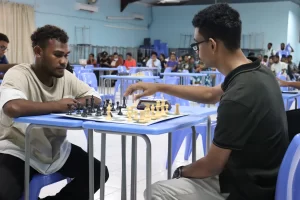
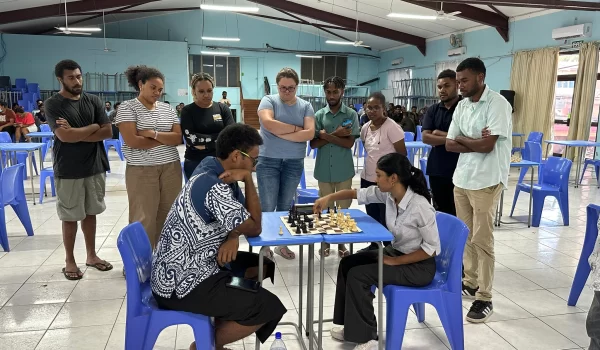
To celebrate World Chess Day, the University held its first-ever Student Blitz Chess Competition on Friday, July 18, 2025. The event took place at the University’s Main Hall and included 14 players who competed in seven fast-paced rounds.

Vice-Chancellor Professor Shaista Shameem said the event was a great way to mark World Chess Day and showed how UniFiji is using games like chess to help students think better and learn more.

“The University’s international chess profile has grown from strength to strength ever since it was first offered as a stress-buster during the Covid lockdowns when students of the University were encouraged to play chess online”.

She said that the game of chess was supported fully at the University due to its value in strategic thinking, mental dexterity and building the competitive spirit required for intellectual innovation and systemic development.

“Students who play chess do very well in their studies, and the University sees chess as a value-added learning tool”, she said.

Chief Arbiter Ricardo Gregorio C. Corpuz III ran the competition and said that this was a big moment for UniFiji as this is the first of many tournaments for the university.

“It started from here, then we will be having more tournaments. This will invite new players and students to play chess.”

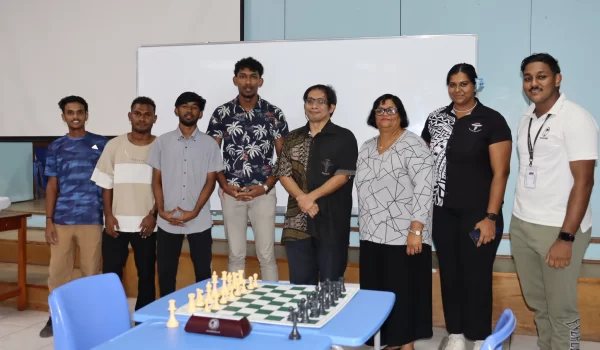
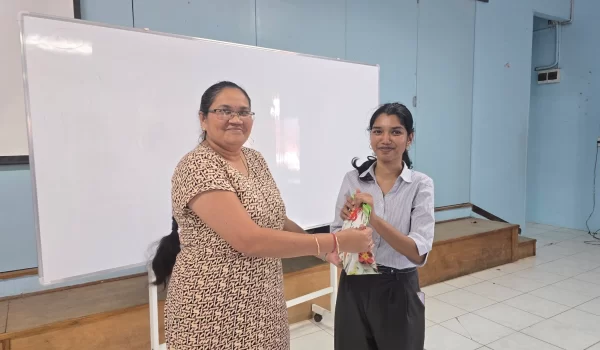
Winners of the day were:
– Men’s Champion: Erick Auto (MBBS 1)
– Women’s Champion: Avani Lingam (MBBS 2)

The Chess in UniFiji program is growing. It now includes games between staff, tournaments for primary and secondary school students, and even international online events. In partnership with the Fiji Chess Federation, the university is helping young people learn new skills through chess while building a strong image for UniFiji in the Western Division.

UniFiji students also joined an international online chess competition through Lichess, where they played with students from other countries. This showed UniFiji’s commitment to new ideas and global learning.

During his speech at the 2025 Kasparov Chess Foundation University Cup, Garry Kasparov said that UniFiji was “leading the way in using chess to foster strategic literacy and intergenerational learning.”

With more tournaments and outreach events planned, UniFiji is committed to helping students become smart thinkers, disciplined learners, and future leaders one move at a time.

517902977_1160826942756658_6163332101373147164_n.webp
518239026_1160826729423346_1041147794503770344_n.webp
518946538_1160826872756665_2822413862410238489_n.webp
518273093_1160826822756670_5501658508249249000_n.webp

Loading