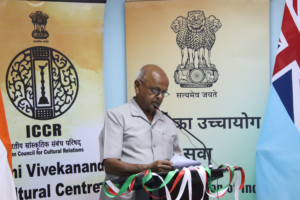
Pundit Vishnu Deo Memorial Hall, Saweni.
The University of Fiji’s Legal Team today made comprehensive public submissions on three parliamentary bills before the Justice, Law and Human Rights Standing Committee of Parliament at the Vishnu Deo Memorial Hall of the University at Saweni.
Addressing the members of the Standing Committee, the Vice Chancellor, Professor Shaista Shameem, said it was of historical importance that the Committee was holding its public consultations in a hall named after one of Fiji’s pre-eminent leaders during colonial times, Pundit Vishnu Deo, in whose name not only the Main Hall of the University but primary and secondary schools in Fiji continued to operate.
Professor Shameem said that very first Fiji-born leader of Indo-Fijians, Pundit Vishnu Deo, had enjoyed bi-partisan support during his terms in the colonial Parliament and was well-known for standing up for human rights and against discrimination of all forms. He supported the idea of a cast-less society, education of girls and promoted re-marriage of widows as well as an end to child marriage. He first won a seat in the Legislative Council in 1929 and was subsequently appointed to the Executive Council in the 1940s. By virtue of his length of service in the Legislative Council Pundit Vishnu Deo was accorded the title of the ‘Father of the House’ by the European Member for the Eastern Division H.B. Gibson, thus placing Pt Vishnu Deo in the annals of Fiji’s history as an eminent Fijian leader alongside Ratu Sir Lala Sukuna. She said that records show that Ratu Sukuna and Pundit Vishnu Deo shared a close personal friendship and mutual respect, bridging the ethnic divide in colonial Fiji. As leaders of their respective communities they promoted cooperation with Pundit Vishnu Deo supporting Ratu Sukuna’s role as the first Speaker of the Legislative Council. He was not only a religious leader but also an educationist, protector of cane farmers and a media personality with his own radio show and newspaper, the Fiji Samachar.
She said that anyone aspiring to be a parliamentarian or a leader should take time to study the strategies of Pundit Vishu Deo on behalf of the community as he was a selfless man of the people.
Pundit Vishnu Deo was a true Renaissance Man and the University’s submissions to the Standing Committee on Justice, Law and Human Rights were made from that renaissance foundation, she said.
Professor Shameem said the University was proud to be presenting its submissions in the Hall named after him as the father also of the Arya Pratinidhi Sabha the founders of the University of Fiji.
National Referendum Bill No 46 of 2025.
The legal basis of the University’s submissions on the National Referendum Bill was Fiji’s 2013 Constitution section 160 subsections 3-6, where the authority for holding a national referendum lies, and not on the Supreme Court Advisory Opinion, Professor Shameem said. The National Referendum Bill found lawful authority in the Constitution and nothing in the Supreme Court Advisory Opinion added any value to the clauses as drafted. By locating the University’s submissions in the Constitutional section 160 (3), (4), (5) and (6) the need for any discussion about the separation of powers doctrine that was raised by the University’s law students in relation to the Opinion could be avoided, she said.
Professor Shameem said that the submissions are completely in favour of all the clauses in the draft bill, except for a number of minor amendments that were needed for clarity. For example, section 30 where reference to a person issuing publication of a notice of referendum should be clearly stated as referring to the Supervisor of Elections or his or her delegate.
The only major amendment was needed for sections 22 (1) display of badges and symbols, and section 23 (1) (b) on canvassing, where both were prohibited at ‘any time’ and ‘for any purpose’, thus breaching the section 150 Freedom of Information provision in the Constitution. Thus sections 22 (1) and 23 (1) (b) were unconstitutional, she said. Dissemination of information was to be permitted to inform the public and this also covered teaching at universities.
Education Bill No 34 of 2025
Professor Shameem commended the Ministry of Education for Education Bill No 34, stating that it was modern, upheld the right to education without discrimination, and complied with regard to judgments of the court on prohibition of violence against children by public institutions.
She said the University had worked closely with the Ministry of Education over a period of over three years to ensure that every person had the right to education in Fiji through a robust educational system from cradle to the final resting place, hence early childhood education to continuing education for adults were all represented in the Bill.
The University had also stated during consultations that, due to the difficulties it had experienced with the higher education review process, the University Council had recommended that the higher education framework be included in the substantive Education Act for transparency and oversight by properly qualified higher education experts. She said the University was pleased that this had been included.
However, Professor Shameem said that some of the clauses in the Higher Education sections of the Act needed strengthening to retain Universities’ programme self-accreditation status which protected academic freedom provided in the three Universities legislations. The bill had mixed up accreditation of universities with accreditation of programmes. Accreditation of universities was similar to registration which allowed oversight by the Ministry to prevent fly-by-night higher educational entities from exploiting young people. However, accreditation of programmes was a matter for the universities to determine in accordance with academic freedom. She said that section 31 of the Constitution not only gave every individual the right to further education but by virtue of section 31 (4) the state could direct educational institutions to provide education only or exclusively for three areas- health, civic education and areas of national interest. The state could not direct higher educational institutions to offer programmes for any interest group such as industry as it would breach the right to education protected by section 31.
She also said that the University wanted to ensure that the new Education Act set out the qualifications required of those appointed to the Higher Education Commission. For that reason, the Higher Education Act 2008 and regulations on qualifications for appointment needed emphasizing. Similarly, the review of higher education institutions needed to follow the direction set out in the current Higher Education Act as, otherwise, the outcome of such review would not be respected by the institutions as happened recently with the review of the three universities by a Committee that was only partly qualified to do so, leading to challenges from the institutions themselves.
Professor Shameem said that the power to compel information from the institutions by the Higher Education Commission in the current draft of the bill was too broad and could be an arbitrary exercise of power unless it was a reasonable request that would not jeopardize the right to privacy of students and staff.
Professor Shameem also addressed the call for micro qualifications, stating that the University recommended regulation and recognition of micro-credentials but not as formal qualifications, and they should be delivered exclusively by relevant and suitably qualified institutions.
Two further supplementary submissions on the Education Bill were addressed by the University’s legal team, namely corporal punishment and mandatory national service.
Professor Shameem said that the University agreed with the Minister of Education that corporal punishment should remain prohibited in schools citing the Fiji Human Rights Commission High Court case of Naushad Ali v the State delivered by Justice Jayant Prakash in 2001. Professor Shameem said that it had not been proven that violence against children made behavioral problems go away. Violence against children was the same as violence against women and both should be prohibited, she said.
On the other hand, discipline of young people did not have to include violence and the Education Ministry would be able to issue discipline guidelines to head teachers and principals as was the case in other jurisdictions such as Australia.
Professor Shameem also referred to the University’s earlier submissions during the Education consultation three years ago where the notion of mandatory national service for young people between the ages of 18 and 25 was first proposed. Professor Shameem said that since then Fiji’s rampant youth drug problem and cases of HIV have exploded with 80% of new cases in the 15-34 age group, as internationally and embarrassingly reported, and, in full agreement with Pacific youth advocate and community specialist Mathew Broderick who promoted the extension of cadet training in schools, the University thinks that a period of national service for young people would mitigate the risk of social evils from being transferred to the next generation. She said some people may think that corporal punishment should be inflicted on youths in trouble but national service was a better option.
Criminal Records Bill No 41 of 2025.
In presenting the University’s submissions on the Criminal Records Bill, Professor Shameem said this Bill could be described as the ‘Alice in Wonderland’ Bill since trying to understand it felt like falling down a rabbit hole with no hope of coming up again.
She said Bill No 41 suffered from two main failures; the first was confusion and deficiency in the drafting and the second was its one-sided focus on the rights of offenders and not on the rights of victims of crime. The bill’s reference to convicted criminals to be ‘respected and seen as a valued member of the community’ overtook the need to take responsibility for harm caused not only to society but also to the individual. Reference to victim statements was only discretionary on the part of a magistrate to whom an application for a spent conviction was made and this made the whole bill lop-sided, Professor Shameem said.
She said the purpose of law, as she often told her law students, was four-fold; namely, to maintain order and safety in society; to provide for justice and rights; to resolve disputes; and to establish common standards. Bill No 41 served not a single social purpose, she said. She said that anyone drafting such a bill should have read three texts: Social Contract by John Locke, Crime and Punishment by Dostoevsky and Discipline and Punish by Foucault. The first sets out the respective rights of state and citizen in maintaining order, the second states that crime remains on one’s conscience, and the third states that the idea of discipline should not be misunderstood as a societal reference.
Professor Shameem said that in terms of the social contract, section 33 of the Bill breaches the section 26 constitutional right to equality and freedom from discrimination provisions in the Constitution by allowing a historical larceny offence to be removed from the record if the offender could claim that he or she committed the offences in certain of the (former) Penal Code larceny sections for any customary purpose. These sections of the Penal Code make no mention of any customary rights issues in relation to the offence of larceny, referring only to larceny of dog, beast, bird and fish and breaking of fences. She said the victim also would not have accepted any customary justification from the offender otherwise it would not have been reported to the police in the first place if both sides accepted that the offence was not larceny but a customary practice. Hence section 33 of the Bill, giving the Permanent Secretary authority only to an indigenous person to be eligible for an application for removing his or her criminal record, would be unconstitutional.
She informed the Committee that Fiji had adopted the UN Declaration on the Rights of Minorities in 1992, hence was obligated to ensure that rights of cultural, political and linguistic minorities of Fiji were respected and promoted and that such minorities were free from any type of discrimination or separate treatment by the state. Hence the Criminal Records Bill has the potential of breaching international law as well as the Constitution if it ignores minority groups in its definition of who is eligible to make applications under the proposed Act.
Other serious deficiencies in the Criminal Records Bill are as follows:
- The term ‘aboriginal’ is used interchangeably with the term ‘indigenous’ with no explanation as to whether this has an Australian reference as this term does not appear in the Constitution.
- The term ‘customary rights’ is used without adequate interpretation;
- For historical offences where an application for expunging a deceased person’s name from the criminal record is made, only ‘kin’ exclusively can make that application but not friends or another relationship; this exclusivity is unfair;
- Rehabilitation periods are 4 years and 7 years for not serious/serious crimes respectively; but crimes against women are not included where they should be and these 4 year and 7 year rehabilitation periods may be too short for certain kinds of crimes;
- Rehabilitation is a culturally-defined term; yet there is no sensitivity in the Bill to other cultures’ notions of rehabilitation;
- Magistrate Court has been given discretion to order a rehabilitation report (‘may’). This is not sufficiently protective of society;
- For removal of a criminal record, there is the condition of ‘attempt to change’. The word ‘attempt’ is subjective. There is inadequate meaning of what ‘attempt’ to change means;
- A spent conviction is defined (inter-alia) as one where there is a finding of guilt but conviction is not recorded, meaning that the finding of guilt is not significant; however, society might think differently about whether there should be awareness as to the guilt of the offender, particularly in certain employment situations whether or not a conviction was actually recorded;
- The Permanent Secretary is given authority to determine whether consent was given for a historical homosexual offence; however, this should be a judicial matter not a bureaucratic one.
- An offender whose record has been expunged or spent can lie under oath about his previous conviction- this is encouraging a person to lie on a holy book and sets a bad example.
- The Bill applies to all employment and other situations except for the RFMF, Corrections, Police, Judicial officers and security intelligence services: not clear why these are exempt. If, as the Bill states in its ‘rehabilitation, forgiveness and respect’ principles that a person convicted of an offence should be respected, valued and supported, then why are RFMF, Police etc exempt from participating in these admirable sentiments?
The Bill suffers from so many flaws in drafting as well as constitutionality that it will inflict a very dangerous precedent in society and compromise safety and security of the people of Fiji if it is enacted in its present form.
We recommend that Parliament request the drafters to consider New Zealand’s Clean Slate Act as well as consider the idea which has more integrity, and that is, that guilty and convicted persons should declare their criminal records honestly and understand that for certain convictions, for example fraud, or dangerous driving, the chances of being employed in a bank or as a courier driver would be unlikely. It would be the same with other specific offences. However, this does not prevent a convicted person from being employed in other positions. The Employer also has the right to know who he or she is employing to mitigate risks to other employees as well or else insurance and indemnity cover can be affected.
The question is whether Bill No 41 ever went for public consultation as it appears not.