
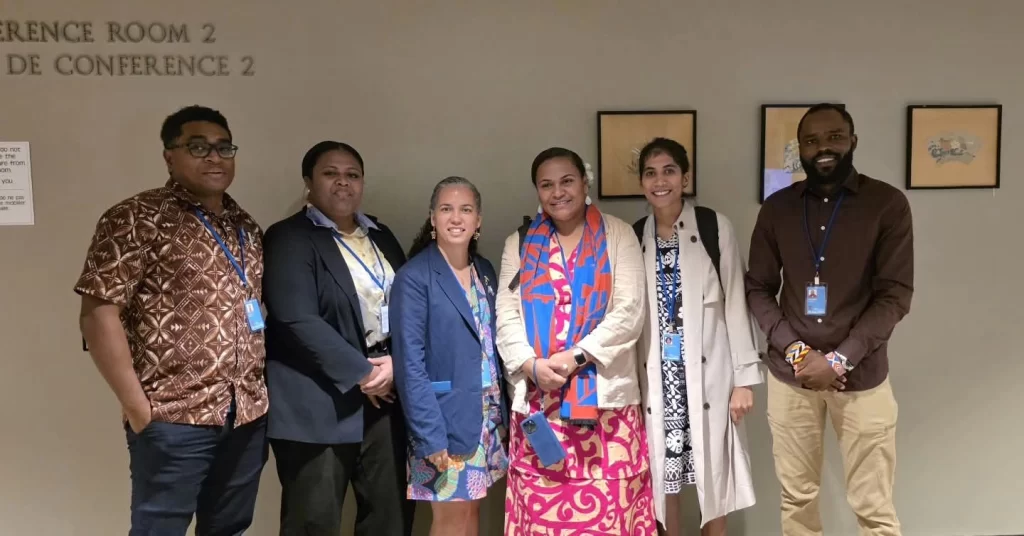
The University of Fiji’s Drua Project Coordinator, Mr. Setareki Ledua, proudly represented UniFiji at the Biodiversity Beyond National Jurisdiction (BBNJ) Preparatory Commission held on Thursday, 28 August 2025, at the United Nations Headquarters, New York.
Mr. Ledua advanced UniFiji’s voice in global conversations on inclusive ocean governance and traditional knowledge, ensuring that the Pacific and the University of Fiji were both visible at this important international forum.
This participation provided not only an opportunity to stand for the Pacific but, most importantly, to showcase the University of Fiji on the international stage.
The BBNJ Agreement is a new, legally binding instrument under UNCLOS focused on conserving and sustainably using marine biodiversity in areas beyond national jurisdiction (ABNJ), which make up nearly two-thirds of the ocean. As the third implementing agreement under UNCLOS, it addresses key gaps in ocean governance across four pillars: marine genetic resources and benefit sharing; area-based management tools including marine protected areas; environmental impact assessments; and capacity building and transfer of marine technology. Adopted in 2023, the treaty will enter into force 120 days after the 60th ratification is deposited with the UN Secretary-General.
A distinctive feature of the BBNJ Agreement is its recognition of Indigenous Peoples and Local Communities (IPLCs), including provisions for integrating traditional knowledge alongside science, participation in governance, and dedicated funding to support IPLC conservation programmes.
Reflecting on his participation, Mr. Ledua said his involvement at the BBNJ Preparatory Commission elevated the University of Fiji’s visibility in international policy forums while creating new opportunities for the institution. He highlighted that this representation opens practical pathways for collaborative research and teaching in areas such as ABNJ conservation, ocean law, and traditional knowledge. It also encourages student and staff engagement with emerging BBNJ institutions, including the Scientific and Technical Body and the Clearing-House Mechanism, while fostering partnerships for capacity building and technology transfer that prioritize Pacific needs and perspectives.
Mr. Ledua further stressed the importance of policy influence, particularly through proposals to embed IPLC leadership via an IPLC Advisory Mechanism to guide area-based management tools (ABMTs), environmental impact assessments (EIAs), capacity building initiatives, and fair benefit-sharing.
Speaking at the conference he emphasized that the “Indigenous Peoples and Local Communities are not peripheral to ocean governance, they are central. Their ancestral knowledge, cultural practices, and lived stewardship offer not only wisdom but solutions for the challenges we face in protecting biodiversity beyond national jurisdiction. The BBNJ Agreement must not be implemented in isolation from those who have safeguarded marine ecosystems for generations. Inclusion is not charity – it is justice. It is effectiveness. It is resilience. We call on all delegates, institutions, and partners to ensure that IPLC voices are not just heard but embedded in the heart of BBNJ implementation. Let this event be the beginning of a sustained commitment to co-governance, equity, and respect. Together, we can shape a future where the ocean is protected not only by policy – but by people.”
Vice-Chancellor, Professor Shaista Shameem, congratulated Mr. Ledua on his achievement, describing it as an important milestone for UniFiji and the Pacific.
Professor Shameem said the University’s Drua Project and it’s contribution to the BBNJ parliamentary select committee process in Fiji where the University’s JDP School of Law made strong submissions supporting Fiji Government’s ratification of the Agreement was preparation for Captain Ledua’s participation in New York.
She said the University is involved in a number of international research projects with other university partners in Europe to ensure the high seas and coastal issues stemming from relentless commercial activity such as mining and fishing are properly addressed through both international and domestic law. Furthermore, the University of Fiji takes every opportunity, budget permitting, to attend meetings in the international fora to which it actively contributes through its unique human values perspective on crises of the 21st century such as economic and labour exploitation, commercial hyper-activity and geo-political tensions within the bloc realignments currently taking place, she said.
The University as Fiji’s primary independent think-tank was being identified more and more internationally as being able to express a perspective based on equity and common sense, Professor Shameem said. The University’s participation in the BBNJ high level strategy meeting was an indication of its inclusive community- based voice much needed for significant developments in international relations with the Ocean Pacific as it’s moral compass she said.
She added that Mr. Ledua’s contribution not only reflects his personal dedication but also strengthens the University’s vision of combining academic excellence with cultural knowledge to influence global policy.
The University of Fiji commends Mr. Ledua for representing the institution with distinction and looks forward to the opportunities, networks, and collaborations that will emerge from his participation on the international stage.

