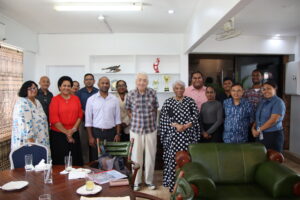
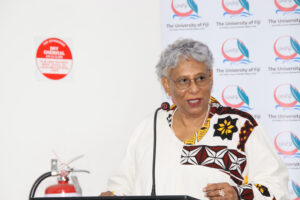
The University of Fiji had the honour of hosting Dr. Michael Horowitz, Dean of Atenisi Institute, Tonga, during his two day visit to the Saweni Campus this week. Dr. Horowitz, whose role as Dean is equivalent to Vice-Chancellor, engaged with University leadership and held discussions with staff and students.
University of Fiji Vice-Chancellor, Professor Shaista Shameem warmly welcomed Dr. Horowitz acknowledging that the purpose of his visit was to explore areas of collaboration between Atenisi and the University of Fiji.
These areas of collaboration will focus on shared academic values, the internationalization of Pacific higher education, and the critical role universities play in shaping socially responsible graduates.
‘Atenisi’s education is founded on freedom of thought and intellect. It’s students are taught to critique all types of dogma. The University of Fiji has at its own foundation the aim to be the critic and conscience of society and a human value think tank for the public good. It was inevitable that such like-minded higher education institutions, in neighboring countries, would reach out to each other in the spirit of partnership, particularly during times of uncertainty’, Professor Shameem said.
She said the University was impressed with the depth of Atenisi’s curriculum based on philosophies, both ancient and modern, as well as science, art, humanities, law, languages and performance. Atenisi’s students were deeply thoughtful, inquisitive in knowledge and of practical mind at the same time, the Vice Chancellor said. The University looked forward to staff and students exchanges with Atenisi, and for scholarly joint publications in interdisciplinary studies.
In the meeting, Dr. Horowitz highlighted the intellectual strengths of smaller Pacific institutions, stressing that academic quality is measured not by student numbers but by creative, well-researched scholarship. He also spoke about the need for universities to cultivate conscience, critical judgment, and global awareness in their graduates’ values which he believes are essential to addressing the pressing challenges of the 21st century.
Reflecting on his experience at UniFiji, Dr. Horowitz expressed his appreciation for the warm hospitality and enriching exchange of ideas.
“This partnership is not about who is large or small; it is about intellectual clout. Both Atenisi and UniFiji have much to contribute through rigorous scholarship and by nurturing values that guide graduates beyond their academic years.”
He further noted that student and faculty exchanges could significantly strengthen internationalisation, broadening perspectives and enriching interdisciplinary scholarship across the Pacific.
The University of Fiji looks forward to building on this dialogue to explore joint research initiatives, student exchanges, and academic collaborations with Atenisi Institute, ensuring both institutions continue to serve as vital centres of learning and thought leadership in the Pacific.
Dr. Horowitz also added that the future of higher education in the Pacific depends on producing environmentally conscious graduates willing to make sacrifices for the planet’s wellbeing.
He further endorsed UniFiji’s vision of expanding the humanities and social sciences, noting that literature, philosophy, history, and related disciplines are essential for developing well-rounded graduates even those pursuing science and technical fields.
The University of Fiji’s Review of the Education Act 1966- Aspirational to Action, Transforming Education through Legislative Reform: Submissions to the Law Reform Commission and the Ministry of Education.
The University of Fiji is pleased to announce the completion of its comprehensive review of the Education Act 1966. The final submission was made to the Fiji Reform Commission and the Ministry of Education today.
In its submissions the University of Fiji Vice Chancellor Professor Shaista Shameem thanked the Ministry of Education and Fiji Law Reform Commission for initiating the review and prioritizing the future education in Fiji.
“As a significant higher education institution, with campuses in Saweni, Ba and Samabula, and an office in Levuka, the University hopes that its recommendations, reached after a significant period of consultations with its stakeholders, will be helpful to the Ministry as it moves towards enacting a 21st century modern educational service for the development of the nation, especially focused on young people”, she said.
The submission aligns Fiji’s international commitments to the right to education as well as to the 2013 Constitution and national development goals. The submission recommends adopting a policy so that no child is excluded or left behind due to a flawed or ineffective system. The University said that all children deserved an education system that empowers, protects, supports and uplifts and are not hampered by system failures or outmoded legislation.
Professor Shameem said that the authorities needed to ensure that the Education Ministry was properly resourced to provide a holistic and human values-based education for Fiji’s young people as they were the future of the nation.
Significant recommendations from UniFiji include:
a) Compulsory Schooling from age 5 – 18 or year 12/13 equivalent.
• Mandate compulsory schooling from age 5 until completion of Year 12 or 18 years, whichever comes first;
• Impose a statutory duty on parents and legal guardians to ensure that their children are enrolled in school and regularly attend classes;
• Include all geographical areas of Fiji under compulsory free education, without exclusions.
b) National Curriculum- Mandate a robust and relevant national curriculum and ensure that key learning areas, starting from primary schools, are prescribed and that the curriculum is age appropriate, inclusive, culturally sensitive and responsive, and have integrated critical thinking, digital literacy, financial literacy, climate education, civic responsibilities and basic legal education. The national curriculum must be monitored regularly and reviewed every 2 years by an independent and permanent Education Commission established for the purpose.
c) Truancy Prevention & Enforcement- Ministry to appoint & empower “Attendance Watch Officers” to actively monitor public spaces during school hours daily to identify school age children who are not in class without lawful reason and escort them back to school or home. This will also significantly reduce drug & sexual related offences involving children and young people in Fiji, which is a growing concern. Work closely with schools and legal guardians to ensure the children are closely monitored throughout the hours of school.
d) Integration of Education Act 1966 & Higher Education Act 2008- proposed to be replaced by a single combined overall legislation, “Education Act”. This overall legislation should cover the entire education system of Fiji from Early Childhood to Tertiary. Also, re-designate the Higher Education Commission as a dedicated Department under the Ministry of Education with appropriately qualified and experienced educators at all levels. This will ensure that there is proper governance, policy consistency, oversight and legal alignment across all levels of education in Fiji.
e) Health, Safety & Well-being – Place a legal obligation on schools to provide a safe and supportive learning environment, mental & wellbeing support (including access to free trained counsellors or psychologists in each school), and an emergency preparedness unit. Also mandate provision of free school meals (breakfast and/or lunch) to ensure all children have access to at least one nutritious meal a day.
f) School Retention & Performance- Mandate early intervention and catch-up programs to identify and support students at risk, improve performance and reduce drop-out rates through early tailored learning & support programmes.
g) Teacher Quality & Development- review standards for teacher qualifications, registration performance development and evaluation. Re-introduce school inspectors.
h) Governance & Accountability- Strengthen governance and accountability provisions in the Education Act (including management of schools). The Act must clearly outline a clear reporting and decision-making structure to ensure accountability and operational efficiency and to create a more responsive, accountable, adaptive, impactful, effective and transparent education system in Fiji
i) Rights-based Approach to education- ensure that children’s best interests and right to education are the heart of the new education system. Ensure alignment with constitutional guarantees, international obligations of Fiji and dignity, inclusion and equity as core principles;
j) Attendance Management- Introduce a framework to actively monitor student absenteeism, with mandatory thresholds (e.g. 5–10 consecutive days or excessive absences) that trigger early intervention, parental engagement, referrals to the Ministry and compulsory school attendance responses.
k) Discipline in Schools- Empower the Minister to issue guidelines for fair discipline codes to enhance classroom conduct with fewer disruptions, and promote a respectful learning environment which is crucial for student success. Implement reasonable disciplinary measures which allow students to learn from mistakes.
l) Establish an Independent Authority to evaluate legislative effectiveness- responsible for systematically collecting, analyzing and reporting data on identified key performance indicators such as access, equity, student learning outcomes, absenteeism, infrastructure, teacher effectiveness, retention rates, implementation and impact of prevention and intervention programs, to suggest future reforms, budget planning, resource management and stakeholder accountability. Reports should be made publicity available for transparency and public confidence. The proposed standing Education Commission can be the independent authority.
m) School inspections- to be carried out annually to ensure compliance with safety, health, infrastructure and requirements of the Act. If breaches are identified, to take appropriate enforcement action and impose penalties.
n) Inclusive Education- ensure that every child differently-abled child or with learning/special needs has access to quality education through mainstreaming or designated special schools, based on the individual’s needs after consultation with parents/legal guardians.
o) Offences & Penalties- Clearly outline and prescribe offences under the Act, including but not limited to, parents or legal guardians’ failure to enroll and ensure attendance, operating unregistered schools, vesting of qualified school management, obstruction of authorized officers, failure to comply with corrective plan (post inspections), failure to comply with requirements for student health, safety and well-being or any other breaches under the Act. Prescribe appropriate penalties, such as fines, prosecution, suspension of licences etc which should be proportionate to the nature and severity of each offence.
Professor Shaista Shameem said that the University’s comprehensive review of the education sector had identified critical shortcomings and gaps in the current Education Act. This is due to the evolving needs of Fiji’s future including in leadership, educators and society as a whole. She said that the current legislation no longer reflects the realities of our classroom, rights of our children and ambitions of our nation.
The legislative gaps are not minor- they are systemic which require a transformative reform.
The University’s submissions do not proposed merely a legal update but a bold and necessary re-alignment of Fiji’s education system with the needs of every Fijian learner, modern expectations and Fiji’s international obligations. Each recommendation, from mandating compulsory education, early intervention models, annual school inspections, emergency protocols to embedding mental health & wellbeing, nutrition, sanitation, infrastructure, is aimed to build a system that protects, empowers and supports young people from the age of 5 years to tertiary.
It represents a national investment in Fiji’s future to build a resilient, inclusive, future-ready, knowledge-based, adaptive, rights-based, sustainable quality-focused and learner centered education system. Every child deserves more than access to education, they deserve a system that protects and works for them, Professor Shameem said.
The University of Fiji joins the nation in commemorating Ratu Sir Lala Sukuna Day, acknowledging the enduring contributions of one of Fiji’s most distinguished national figures mainly as a legacy for future leaders.
In a statement marking the day, University of Fiji Vice-Chancellor Professor Shaista Shameem reflected on Ratu Sir Lala Sukuna’s lifelong dedication to public service and duty.
“There are some important lessons to be learnt from the legacy of Ratu Sir Lala Sukuna, the most important of which, for present and future leadership, is selfless duty in the service of others”, she said.
Professor Shameem said that Ratu Sukuna was multi-skilled, with achievements that spanned across education, law, governance, and military service, including becoming the first iTaukei university graduate, serving in World War I despite the obstacles he faced, and, later, shaping governance and bureaucracy in colonial Fiji. She said Ratu Sukuna was a thinker who was both charismatic and humble.
She said it was undoubtedly his youthful experiences in Fiji that had shaped Ratu Sukuna which allowed him to find opportunities despite the hardships he faced during his overseas sojourns, including discrimination and impoverishment, judging by the articulate letters he wrote home.
The University of Fiji recognized the human values attributes of Ratu Sir Lala Sukuna which resonates with the University’s own philosophy of education even now, despite the passage of time, Professor Shameem said.
She said the significance of Ratu Sukuna Day was a reminder to the University staff and students of the value of honest leadership in national life.
The University of Fiji and the Sri Sathya Sai Global Council Fiji Pte Ltd (SSSGC) have signed a Memorandum of Understanding (MoU) to enhance medical education and strengthen community health initiatives across Fiji and the Pacific.
The agreement, signed during the University’s International Health Conference, cements a growing partnership between academia and service that has already seen more than 17 University of Fiji students participate in SSSGC’s outreach programmes.
It now sets a formal framework for broader cooperation from clinical placements abroad to free medical camps at home. The MoU outlines a practical and values-based collaboration designed to empower the next generation of healthcare professionals through service and exposure to global best practices.
Under the agreement, SSSGC will support University of Fiji medical students and staff through:
Annual scholarships for final-year MBBS students to undertake immersive clinical training in Australia, New Zealand, or other internationally recognised centres of excellence.
Participation in SSSGC’s Annual Free Medical Clinics across Fiji, offering real-world medical experience in underserved communities.
Professional development webinars and seminars, both online and in-person, led by internationally respected healthcare professionals.
Tailored project-based collaborations designed to meet Fiji’s evolving healthcare priorities through joint planning and resource sharing.
Vice-Chancellor of the University of Fiji, Professor Shaista Shameem, described the MoU as more than a policy instrument but a platform for shared purpose.
“We are pleased to be finalizing the Memorandum of Understanding to further deepen our collaboration, opening new avenues for joint projects, community outreach, and shared growth. This partnership reflects our commitment to developing medical professionals who are not only skilled but also driven by service and compassion.”
She added that this partnership is not just about academic opportunities, it’s about instilling a deeper sense of purpose in our students.
“Through hands-on service, they will learn that medicine is not only a science but also an act of compassion.”
“Our students will not only gain international exposure but also return with a greater sense of duty to serve locally. This is how we build healthcare leaders who understand both the technical and human side of medicine.”
Mr. Anil Kumar Amin, National President of SSSGC Fiji, acknowledged the longstanding cooperation that has led to this formal agreement.
“It is an absolute honour to witness the signing of this inaugural collaboration. Our organization is grounded in the values of love and service, and this partnership allows us to nurture the next generation of medical professionals while continuing our humanitarian work across Fiji.”
“By investing in the next generation of doctors and health professionals, we’re investing in the future health of Fiji. These students will one day serve our communities and we are proud to walk this journey with them.”
“This partnership exemplifies our commitment to action. We don’t just believe in healthcare for all we act on it, alongside like-minded institutions such as the University of Fiji.”
Mr. Kamal Naidu, Special Programs Coordinator- Zone 3 countries (Australia, New Zealand & Fiji), based in Sydney, reflected on the long-term vision and impact of the partnership.
“This MoU is not merely a formal agreement, it is a shared commitment to nation-building. From medical camps to clinical placements and professional development, our programs aim to equip students with both knowledge and compassion. Together, we are building a sustainable and inclusive healthcare future for Fiji.”
With this MoU, the University of Fiji will advance its goal of providing value-based, high-quality training for medical and nursing professionals while ensuring that students are exposed to real-world challenges and solutions.
The agreement will remain in effect for an initial term of three years, with annual performance reviews and the option for a two-year extension. It also reflects a deep commitment from both institutions to empowering communities, expanding healthcare access, and shaping a resilient and responsive health workforce for the Pacific.
The University of Fiji has announced its plans to introduce a Master’s in Orthopedics, as part of its ongoing efforts to expand specialist medical training in the region.
The programme will be launched following necessary approvals from University Senate Committee and Higher Education Commission Fiji (HECF).
The announcement was made by Pro Chancellor Pundit Bhuwan Dutt Arya Ratna during the official opening of the University’s International Health Conference, hosted by the Umanand Prasad School of Medicine and Health Sciences (UPSM).
“This programme is a significant addition to our academic offerings, reaffirming our commitment to addressing the growing demand for specialist care across Fiji and the Pacific,” said Pundit Bhuwan Dutt.
“It reflects our vision to not only train general practitioners, but also develop expertise in critical medical disciplines.”
The proposed Master’s in Orthopaedics will complement UPSM’s current programme offerings, which include the MBBS, Bachelor of Medical and Health Sciences, Bachelor of Nursing, and Bachelor of Public Health.
Since its establishment in 2007, the school has expanded its footprint beyond its main Saweni campus to Samabula and Ba, with graduates now serving in healthcare facilities across the nation.
The announcement was made during the opening ceremony of the International Health Conference, a milestone event for the University of Fiji and the broader Pacific medical community.
Held at the Saweni campus, the conference brings together researchers, academics, clinicians, and public health professionals from Fiji and overseas.
“This conference is a platform for collaboration and innovation,” said Pundit Bhuwan Dutt.
“It opens the doors to deeper research, stronger partnerships, and transformative health interventions that go beyond academic discussion and into real-world application.”
The two-day conference features a diverse programme of plenaries, technical sessions, and panel discussions, addressing both general and specialized areas of healthcare. Topics include health systems resilience, medical technology, regional disease burdens, and community health delivery.
In his keynote address, Pundit Bhuwan Dutt also reminded attendees of the importance of human values in medicine.
“Technical knowledge must be paired with compassion, fairness, and ethics. True healthcare transformation comes when professionals engage both the mind and the heart.”
He urged participants to engage fully and let the outcomes of the conference extend into policy, practice, and long-term partnerships.
The conference also pays tribute to the resilience of health workers across the Pacific, especially in the wake of the COVID-19 pandemic.
The university envisions the event as the first of many international academic gatherings aimed at shaping the future of health in the region.