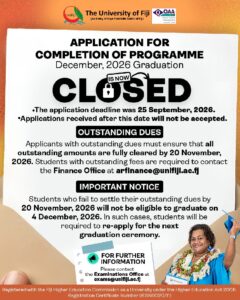
Kindly note that the Application for Completion of Programme is now CLOSED for December, 2026 Graduation. The application deadline was 25 September, 2026, and applications received after this date will not be accepted.
Applicants with outstanding dues must ensure that all outstanding amounts are fully cleared by 20 November, 2026. Students with outstanding fees are required to contact the Finance Office at arfinance@unifiji.ac.fj
Note: Students who fail to settle their outstanding dues by 20 November, 2026 will not be eligible to graduate on 4 December, 2026. In such cases, students will be required to re-apply for the next graduation ceremony.
For further information, please contact the Examinations Office on exams@unifiji.ac.fj
Please find the attached Flyer for the Application for Completion of Programme.
The University of Fiji’s campus radio station, Vox Populi, is set to join hundreds of college radio stations around the world in celebrating World College Radio Day 2026 with a 72-hour live radio marathon under the theme “HOPE – Always in the Air!”
The celebration brings together students, staff and listeners through live broadcasting, entertainment, conversations and interactive programmes, while highlighting the continuing role of radio in connecting communities and providing trusted information.
At the University of Fiji’s Suva Central Campus, preparations for the international celebration have been led by Vox Populi Station Manager Mr Lawrence Singh, with staff and students coming together to support the marathon.
Mr Singh said this year’s theme reflects the important role radio can continue to play when other forms of communication may not always be available or reliable.
“Hope – Always in the Air means that our listeners can always rely on radio communication when all other modes of communication fail,” Mr Singh said.
“Vox was initially born to be just that back in 2021 when Fiji was in the midst of the pandemic and we have remained steadfast in our commitment,’’
Vox Populi will participate in the global celebration through its 72-hour live radio marathon, bringing together programming and activities aimed at engaging its audience.
Mr Singh said the station was grateful for the support of the University of Fiji and Vice Chancellor Professor Shaista Shameem, including prizes for listeners and competitions to be conducted during the marathon.
He said the event would also feature content dedicated as a tribute to the late Dolly Parton.
The marathon will also provide journalism and media students with practical opportunities to develop their broadcasting skills.
Mr Singh said Vox Populi gives students and staff an opportunity to collaborate and participate in an event that has become part of the station’s annual calendar.
“Vox provides a robust platform for students to learn the dynamics of radio and the best part is that this exposes the University of Fiji and its students on a global scale,” he said.
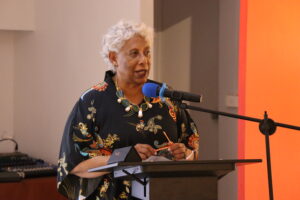
The University of Fiji Vice Chancellor and Vox Populi Producer Professor Shaista Shameem said the theme represents the University’s hope that students would use the radio service to connect with others while enjoying entertainment.
“For us as a University it means we hope all students enjoy 24-hour radio service as a way to manage stress and connect up with other listeners. And hope they all enjoy the wonderful entertainment,” Professor Shameem said.
She said radio remained a powerful medium for young people and that Vox Populi provided students with a platform for self-expression.
“Radio is a powerful medium that reaches out to millions of people, especially young people, for self-expression, and that is our aim,” she said.
Professor Shameem also highlighted the role of Vox Populi in preparing students for careers in journalism, media and communications.
She said the expertise available through the station can encourage students to consider careers in journalism and multimedia studies, while giving them practical exposure to broadcasting.
“Vox talent, in the form of our station manager, allows students to think about a career in journalism and multimedia studies. There’s no better role model than our Vox experts,” Professor Shameem said.
The station also sees itself as an important link between the University and the wider community.
Professor Shameem described radio as “the big connector” between the University and the wider world, adding that Vox Populi could serve as an influencer for the public good.
Mr Singh said the importance of trusted radio broadcasting had become even more significant in the digital age, where misinformation and disinformation could spread rapidly.
“We are in the digital era where the internet has taken over the whole globe but it cannot always be trusted,” he said.
“Misinformation and disinformation is a challenge for societies where anyone can spread any story lacking authenticity but radio can always be relied upon for correct and trusted information.”
“Hope is always on the radio when it comes to fact checking,” Mr Singh said.
Looking towards the future, Mr Singh said he hoped Vox Populi would develop into a fully fledged community service radio station.
He said plans were underway for FM transmission and expressed confidence that the station could eventually reach listeners across Fiji and the wider region.
Mr Singh also said he envisioned Vox Populi becoming increasingly operated by Journalism students, providing them with a practical platform to apply the skills they develop through their studies.
As World College Radio Day 2026 approaches, Vox Populi is encouraging students, staff and members of the public to participate in the 72-hour celebration and take part in the competitions and programmes.
Professor Shameem urged Vox Populi followers to enjoy the marathon and participate in the activities, while Mr Singh emphasised the continuing importance of radio as a platform for trusted information, education, entertainment and community connection. Under the message
“One Voice. One World. One Radio,” Vox Populi will take its place among college radio stations globally, carrying the message that “Hope is Always in the Air.”
The University of Fiji has called for stronger legal and policy protections for older persons, stressing that longer lives must also mean lives lived with dignity, equality, autonomy and security.
The call comes as the world marks the United Nations International Day of Older Persons on 1 October 2026, under the theme “The Age of Longevity: Rethinking Systems for Longer Lives.”
The University of Fiji Vice-Chancellor, Professor Shaista Shameem, said the ageing global population presents significant human rights challenges that require governments and institutions to rethink how older persons are treated and protected.
“As the world grows older, our laws, institutions and policies must keep pace. Older persons are not simply recipients of care or assistance, they are active rights-holders entitled to dignity, autonomy, equality and a meaningful voice in the decisions that affect their lives,” Professor Shameem said.
She said the recognition of older persons’ rights must extend beyond social assistance to include meaningful participation in society and protection under national laws.
In a significant student-led initiative, the University’s Constitutional Law 205 students have drafted a proposed new Constitution for Fiji, titled the Constitution of the Republic of Fiji 2026, which includes provisions promoting and protecting the rights of older persons.
The initiative reflects the importance of recognizing older persons as rights-holders and ensuring that their dignity, equality and protection are embedded within Fiji’s constitutional framework.
While Fiji continues to strengthen its National Ageing Policy, social pensions, free medical schemes and bus fare subsidies, Professor Shameem highlighted the need for further measures to address the challenges facing older persons.
She noted that climate change has compounded these challenges, particularly in the Pacific, where food security, access to clean water, healthcare, economic opportunities and adequate housing remain critical concerns.
Older persons are also increasingly vulnerable to neglect, rising living costs, inadequate pensions and the breakdown of traditional family support structures.
United Nations Secretary-General António Guterres, in his message for the International Day of Older Persons 2026, highlighted that the global population aged 60 and over is projected to increase from 1.2 billion to 2.1 billion by 2050, accounting for approximately 20 per cent of the world’s population.
He emphasized that while increased longevity represents a major achievement in improved healthcare and social protection, it also requires governments to rethink policies relating to employment, pensions, housing, healthcare and lifelong learning.
Professor Shameem said older persons must continue to be recognized for their contributions as leaders, caregivers and valued members of families and communities.
She also encouraged younger generations to demonstrate greater respect and appreciation for older persons.
“Our students are urged to respect and give dignity to older persons at home and around the communities they live in,” Professor Shameem said.
The University of Fiji joins the international community in recognizing the contributions of older persons and advocating for stronger protections to ensure that ageing is accompanied by dignity, security and meaningful participation in society.
Law students at The University of Fiji have drafted and submitted to the Prime Minister a 68-page proposed Constitution for Fiji, setting out the institutions, rights and safeguards they believe should help shape the future their generation will inherit.
The proposed Constitution was drafted collectively over just two weeks by the Constitutional Law 205 Class of 2026 at the Justice Devendra Pathik School of Law as part of an assignment that challenged students to move from studying constitutional law to designing an entire constitutional framework for the country.
The students have also decided to release their proposed Constitution for wider public discussion.
The students’ proposal comes as Fiji is undergoing a wider national constitutional review, with the Constitution Review Commission report scheduled to be tabled in Parliament at a special sitting on 22 September. The LAW 205 document is a separate academic initiative, developed independently by the students as part of their Constitutional Law studies.
Vice-Chancellor Professor Shaista Shameem, lecturer in Constitutional Law 205, said the exercise required students to move beyond studying constitutional principles and engage directly with the difficult choices involved in constitution-making.
“I said to the students at the beginning of the semester that I had made submissions to the Constitutional Review Commission that we did not need a Constitution for Fiji because all our constitutions had brought nothing but instability. I then challenged the Law 205 students to draft a Constitution that would make me change my mind, and they did. They did this collectively through reference to all Fiji’s Constitutions since the 1860s to 2013. It’s a brilliant document and now they are seeking endorsement from the body politic to consider it seriously. I am very proud of them,” Professor Shameem said.
In their message accompanying the proposed Constitution to the Prime Minister, the students said their class represented a demographic that would play an important role in Fiji’s future and that the class itself reflected the broader national demographic.
They said this made it important for the perspectives and preferences of their generation to form part of discussions about Fiji’s constitutional future.
The students also expressed their willingness to have their proposals discussed publicly, leading to their decision to release the document for wider public consideration after respectfully presenting it to the Head of Government.
The proposed Constitution brings together the students’ ideas on how public power should be exercised, how institutions should be structured, how rights should be protected and how governments and public officials should remain accountable to the people.
The document describes itself as a complete proposed constitutional framework, guided by principles including popular sovereignty, democratic governance, constitutional supremacy, the rule of law, separation of powers, independent courts and institutions, accountable public administration, protection of rights and communities, and the peaceful transfer of political power.
Among the proposals is a bicameral Parliament comprising a House of Representatives and a Senate. The proposed House would consist of 71 members, combining geographical constituency representation with proportional representation, while the Senate would provide additional legislative scrutiny and representation for communities and groups that may otherwise be under-represented.
The proposed framework also places significant emphasis on accountability and on the principle that public power must be exercised for the benefit of the people. Its opening provisions state that sovereignty belongs to the people of Fiji and that public office is a public trust.
The students also addressed emerging issues that are increasingly becoming part of constitutional and governance discussions, including personal data protection, internet access, cybercrime, artificial intelligence and automated decision-making.
Under the proposed framework, a person whose important rights or interests are significantly affected by an automated decision could, where appropriate, know that artificial intelligence was materially used, receive an understandable explanation, request human review and challenge an unlawful or discriminatory decision.
The draft also recognises a right to reasonable and affordable access to the internet and calls for reliable and accessible internet services to be progressively promoted throughout Fiji, particularly for rural, maritime and underserved communities.
Environmental protection and the interests of future generations also feature prominently in the students’ work. The proposed Constitution provides for a right to a clean, healthy and sustainable environment and requires the State to take reasonable account of the long-term interests and rights of future generations when making decisions concerning the environment, natural resources, technology, artificial intelligence, public finance and national development.
The document covers constitutional principles, the Bill of Rights, Parliament, the Executive, Judiciary, State and disciplined services, finance and public expenditure, accountability, emergency powers, constitutional accountability, amendment procedures and transitional provisions.
One of the distinctive features of the student-drafted Constitution is its attempt to respond not only to Fiji’s constitutional experience, but also to issues that could increasingly shape governance in the decades ahead.
Alongside the traditional institutions and protections expected in a Constitution, the students have brought digital rights, artificial intelligence, cybersecurity, environmental sustainability and the interests of future generations directly into their proposed constitutional framework.
In doing so, the Constitutional Law 205 Class has produced more than an academic assignment. It is a collective statement by a new generation of law students about the institutions, protections and responsibilities they believe deserve consideration as Fiji thinks about its constitutional future.
The proposed Constitution remains an academic work developed by the Constitutional Law 205 Class of 2026 and is separate from any official Government constitutional drafting process.
To access the constitution, follow the link:
https://drive.google.com/drive/folders/1MpajNUqNuX7JzOPW0wCJxpS8R3jhaAtc?usp=sharing
The University of Fiji has strengthened its international research engagement by contributing Pacific and Small Island Developing States perspectives to discussions on the future of global energy access, climate research and equitable academic partnerships at the University of Oxford.
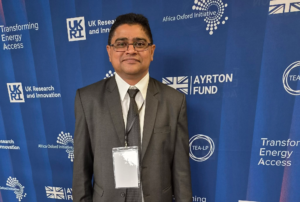
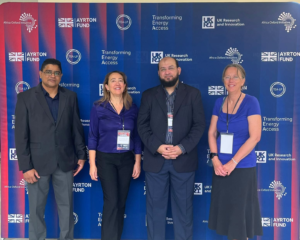
Dr Ramendra Prasad, Associate Professor and Head of Science in the School of Science and Technology, represented UniFiji at the Africa Oxford Initiative and Transforming Energy Access Academic Symposium 2026, held at the University of Oxford in the United Kingdom on 7–8 September. He attended in his capacity as UniFiji Project Lead for the Transforming Energy Access–Learning Partnership project.
Vice-Chancellor Professor Shaista Shameem said the University’s participation reflected the importance of ensuring Pacific institutions are part of international conversations on energy transition, climate action and research collaboration.
“It is very satisfying to see that senior academics of the University are invited to provide insights at prestigious universities abroad especially in research methodologies and SIDS priorities. We expect that our unique experiences will add value to international conversations and roundtables such as these and create impact where it’s needed most.”
The two-day symposium brought together more than 150 academics, practitioners and innovators from the United Kingdom and the Global South to help shape future research and academic partnerships in energy and climate. The programme placed particular emphasis on equitable Global South–North collaboration and ensuring that future research priorities reflect the needs of Global South institutions, communities and energy systems.
The symposium was supported by UK Aid, the Africa Oxford Initiative, the Carbon Trust, the Transforming Energy Access–Learning Partnership and UK Research and Innovation.
Rather than being limited to presentations, the programme was built around facilitated discussions and collaborative sessions. Participants examined the principles of effective and mutually beneficial research partnerships, what should be built, funded or connected next in energy access, and how international research collaborations can move from discussion to implementation.
Dr Prasad participated throughout the two-day programme, contributing perspectives from Fiji, the Pacific and Small Island Developing States to discussions on energy access, research priorities, partnership models and future collaboration.
For UniFiji’s School of Science and Technology, the engagement is closely linked to research and teaching in renewable energy, climate change, environmental science, data-driven modelling and sustainable development. The symposium also provided a framework for connecting scientific research more directly with policy, innovation, implementation and skills development.
The engagement has also created opportunities for UniFiji to strengthen relationships with universities, research networks, practitioners and international organisations, while exploring possible joint research, postgraduate supervision, academic exchanges and future research and funding collaborations.
The University’s participation supports its wider efforts to contribute locally grounded Pacific knowledge to international energy and climate-transition discussions and to strengthen research capability that responds to the needs of Fiji and other Small Island Developing States.