
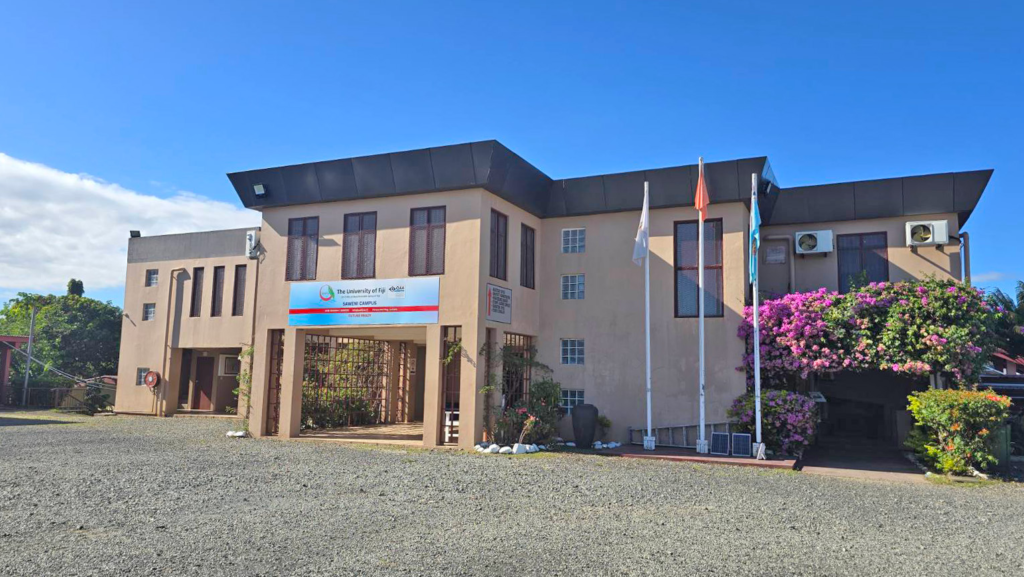
The University of Fiji’s Adjunct Professor Shobha Maharaj has made a significant contribution to a major new United Nations Environment Programme (UNEP) report examining how the world must respond as global temperatures move beyond the 1.5°C warming threshold.
The recently released report, Limiting Overshoot: Navigating exceedance of 1.5°C and pathways towards return, brings together international expertise in climate science, adaptation, mitigation, governance and sustainable development to examine what happens when global warming exceeds 1.5°C and what must be done to limit the magnitude and duration of that overshoot.
Professor Maharaj, an Adjunct Professor at The University of Fiji and Science Lead at its Ecological and Climate Crises Legal Institute (ECCLI), was one of three Lead Authors of Chapter 4 of the report, which focuses on adaptation under climate overshoot.
She was also the sole author of the report’s focused assessment on sea-level rise and the adaptation challenge facing Small Island Developing States (SIDS), giving her contribution particular significance for Fiji and the wider Pacific.
UniFiji Vice-Chancellor Professor Shaista Shameem said Professor Maharaj’s contribution demonstrated the University’s growing international presence in climate research and the importance of Pacific expertise in global discussions on the climate crisis.
“We are obviously out there internationally in this space and grateful for such high level representation by our Adjunct Professor Maharaj who is world renowned for her science and climate crisis work.”
She also co-authored the report’s section on governance, legitimacy and equity, authored its focused assessment on species redistribution and the implications for protected areas, and is listed among members of the report’s Scientific Advisory Board.
The scale of Professor Maharaj’s involvement places University of Fiji expertise within an international assessment dealing with one of the most pressing questions now facing global climate policy, how countries should respond if warming exceeds the 1.5°C target while continuing efforts to bring temperatures back down.
The report says global action to reduce greenhouse gas emissions has not been fast enough to avoid crossing 1.5°C above pre-industrial levels, with exceedance now expected within the next few years. Even an optimistic scenario based on full implementation of current national climate plans and additional net-zero commitments places expected peak warming at around 1.8°C.
Professor Maharaj said one of the report’s most important messages was that the way countries approach climate adaptation would itself have to change.
She said adaptation across the world, particularly in vulnerable regions such as small islands, remained fragmented and inadequate, with much of the work still concentrated on planning rather than implementation.
Many existing adaptation strategies had also been developed around past and present climate conditions, rather than conditions that could emerge as temperatures exceed 1.5°C, reach a peak and potentially decline.
Professor Maharaj said this would require the recalibration of existing adaptation plans, moving away from fixed and often reactive strategies towards anticipatory and flexible approaches capable of adjusting as climate risks and conditions evolve.
“The danger this report exposes is not overshoot alone but the trap of responding to it in a crisis by crisis manner,” Professor Maharaj said.
“Adaptation takes decades to build, so overshoot-calibrated plans must be designed and implemented now, ahead of impacts.”
“Reactive spending drains mitigation and adaptation, deepening overshoot and feeding the next crisis. Breaking this cycle requires anticipatory action, and political will.”
The report supports this concern, finding that where proactive adaptation is inadequate, scarce financial and institutional resources can be repeatedly diverted towards responding to climate disasters rather than invested in longer-term adaptation, mitigation and development.
It notes that this problem is already evident in SIDS, where repeated disaster recovery can reduce the resources available to build long-term resilience despite these countries contributing comparatively little to global emissions.
Professor Maharaj’s work on sea-level rise also highlights why the report has particular significance for Fiji and other Pacific Island countries.
The report warns that sea-level rise for SIDS is not simply a future issue of islands eventually becoming submerged. Loss of habitability can occur much earlier through increasingly frequent flooding, saltwater intrusion into freshwater and farmland, damage to coastal ecosystems and growing pressure on infrastructure and livelihoods.
It notes that most Pacific islands have more than half of their infrastructure within 500 metres of the coast, adding that even higher-elevation islands such as Fiji remain exposed because substantial infrastructure and development are located near shorelines.
A further five to 10 centimetres of sea-level rise, expected roughly between 2030 and 2050, could double the frequency of flooding across much of the tropical Pacific and Indian Ocean.
The report also warns that sea levels will continue rising for centuries to millennia even if global temperatures eventually return to 1.5°C, reinforcing the need for adaptation plans capable of responding to long-term and changing conditions.
UNEP identifies an “overshoot, peak and decline” pathway as the best remaining option, limiting how high temperatures rise above 1.5°C and how long they remain there, while rapidly reducing emissions, strengthening adaptation and ultimately working to bring temperatures back down.
UNEP Executive Director Inger Andersen has warned that there are no good outcomes from remaining above 1.5°C, stressing that emissions reductions must be pursued alongside stronger resilience and adaptation.
The report makes clear that exceeding 1.5°C does not mean the international community should abandon the Paris Agreement temperature goal. Instead, every fraction of a degree of warming avoided and every year by which overshoot is shortened can reduce the loss of lives, damage to ecosystems and economic costs.
Professor Maharaj’s involvement represents a significant contribution by The University of Fiji to this international body of work and helps ensure that the vulnerabilities, experiences and long-term interests of Small Island Developing States are represented as governments and institutions consider the next phase of global climate action.
The full UNEP report, Limiting Overshoot: Navigating exceedance of 1.5°C and pathways towards return, is available at:
https://www.unep.org/resources/limiting-overshoot-navigating-exceedance
Notes to Editors
• Limiting Overshoot: Navigating exceedance of 1.5°C and pathways towards return was released by the United Nations Environment Programme on 2 September 2026.
• Professor Shobha Maharaj is an Adjunct Professor at The University of Fiji and Science Lead at the University’s Ecological and Climate Crises Legal Institute (ECCLI).
• Professor Maharaj was a Lead Author of Chapter 4 of the report, authored its focused assessment on sea-level rise and the SIDS adaptation challenge, co-authored its work on governance, legitimacy and equity, authored its focused assessment concerning species redistribution and protected areas, and served on the report’s Scientific Advisory Board.

