
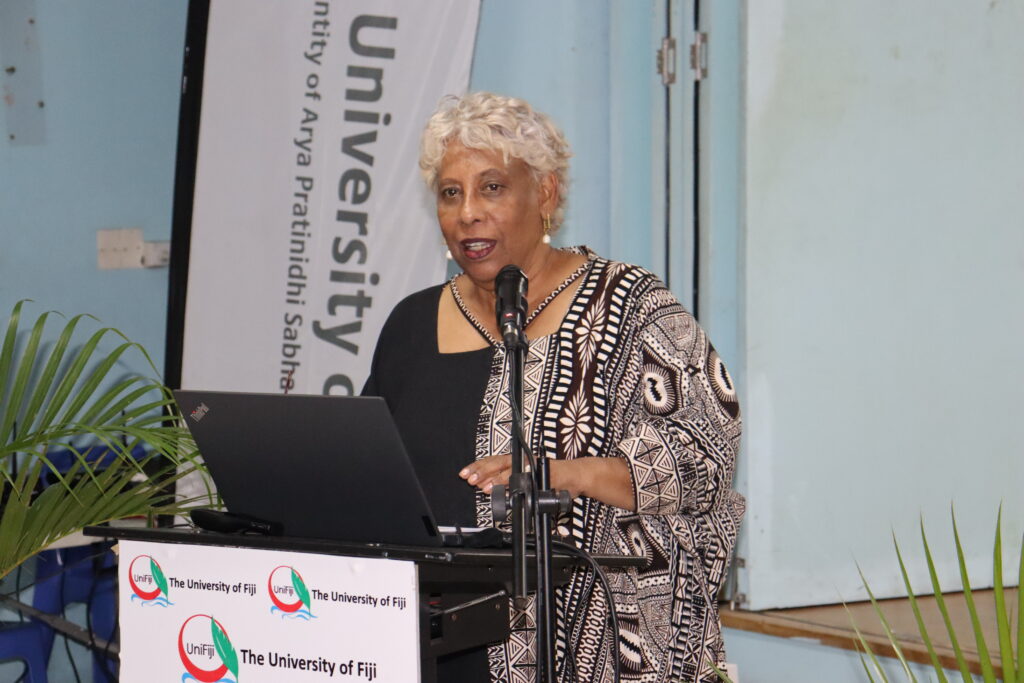
The Vice Chancellor of the University of Fiji and constitutional lawyer, Professor Shaista Shameem questioned the need for a supreme and entrenched Constitution in Fiji when ordinary laws can be made sufficiently robust to cover all relevant legal rights adequately.
Professor Shameem told the Constitutional Law Review Commission that she had asked her law students to justify the need for a higher law when international law as applied to the Fijian context was a more efficient way to ensure everyone could enjoy the same rights as everyone else and equality would be the cornerstone of all state services including the legislature, the executive and the judiciary.
She said that the Constitutions of independent Fiji, from 1970 to 2013 had brought nothing but instability in Fiji because there was no uniform agreement on what a Constitution should contain. Such political instability had thwarted economic growth which could have alleviated poverty. Instead, much public expenditure had been utilized to establish review commissions which drafted new constitutions only to see them being moved aside for yet another one. The longest lasting Constitution was the 2013 Constitution which had survived for 13 years so far, she said.
Professor Shameem said that rather than arguing over provisions of another new Constitution, it would be more fruitful and sustainable to ensure that all ordinary legislation in Fiji complied with international human rights and humanitarian laws applied correctly. She said she was concerned that a number of bills brought to Parliament recently or under public consultation did not comply with international non-derogatory principles. These included the Marine Areas Bill, Indigenous Rights Bill and the Mining Bill. Many of these bills have the effect of causing inequities contrary to international law, she said.
Professor Shameem said that countries such as New Zealand, Australia and even the United Kingdom did not have supreme constitutions but were able to maintain stability due to robust laws.
Professor Shameem also said that some of the presenters before the Commission had advocated the return of policy that resembled the 1990 Constitutional provisions. Had the Rome Statute been in existence in 1990, those drafting it could have been reported to the International Criminal Court for promoting discrimination, for example in Chapter III and sections 31, 41 and 83(2), she said. Fiji signed the Rome Statute in 1999, however, while the Rome Statute contains the rule against retrospectivity, this rule can be set aside for continuing conduct or if the offence committed would be prosecuted domestically had it not been for state immunity granted to the perpetrator. Professor Shameem said that any person who advocated discrimination of any form by law would be subject to the full brunt of international law. She said the Constitutional Review Commissioners should not adopt any of the provisions of the 1990 Constitution even by implication.
Professor Shameem said that should the Commissioners decide that a new Constitution is required, a number of principles had to be incorporated in it to ensure legitimacy. The first was recognition that a Constitution represented the social contract between a state and the people and any breaches of that contract would result in lack of confidence in government and government institutions. Government was seen as the Trustee of people’s will constitutionally.
The second principle was that of equality of all the people and the right to be free from discrimination in access to government and resources. That meant no special privileges for anyone, she said.
The third principle was the right to equal representation whatever the mechanics of election or selection. She said it was important to realise that democracy was a spectrum and people could easily be dragged into totalitarian democracy if the wrong leader was chosen.
The fourth constitutional principle was that of separation of powers which meant that the legislature, executive and the judiciary had separate functions. The courts could not legislate, even impliedly, as that was the role of the legislature, Professor Shameem said.
The fifth principle was taxation for the public good. Taxation was pegged to a sustainable, circular economy and included taxing those who benefitted from access to natural resources, wherever or whatever they were, she said. Professor Shameem said she agreed with the Fiji Institute of Chartered Accountants’ submissions that finance and fiscal policies were a constitutional responsibility.
Professor Shameem also noted that section 173 of the 2013 Constitution, which contains the Constitution’s immunity clauses, is presently the subject of proceedings before the Supreme Court of Fiji, in which the University of Fiji is the petitioner. The issues concerning its interpretation, scope and constitutional effect are therefore sub judice. In those circumstances, she said it would be inappropriate for the Constitutional Review Commission, or for those appearing before it, to express views on the legal merits of section 173. Any consideration of whether section 173 should ultimately be retained, amended or repealed should properly await the Supreme Court’s determination. Accordingly, and out of respect for the independence of the judiciary and the judicial process, the University of Fiji does not propose to comment on section 173 while the matter remains before the Court.
Professor Shameem further said that offences committed against the Constitution or the people were already penalized under the Crimes Act 2009 Parts 10–12. A number of relevant offences had been included in the former Penal Code, for example Chapters VII and VIII, but these had been consolidated under the Crimes Act 2009.
She said that amendment of the Constitution as the highest law required the highest possible majorities and that a 10-year interval was sufficient for constitutional reviews.
Professor Shameem said that the constitutional role of the Disciplined Services, including the RFMF, Police and Corrections, was to look after the welfare of all the people of Fiji.
In conclusion, Professor Shameem said that a human values perspective on constitutionalism would be the best basis for a new Constitution. However, if that was not possible then it would be advisable to do away with the idea of a supreme and entrenched Constitution and instead make ordinary laws more robust and compliant with international law.

