
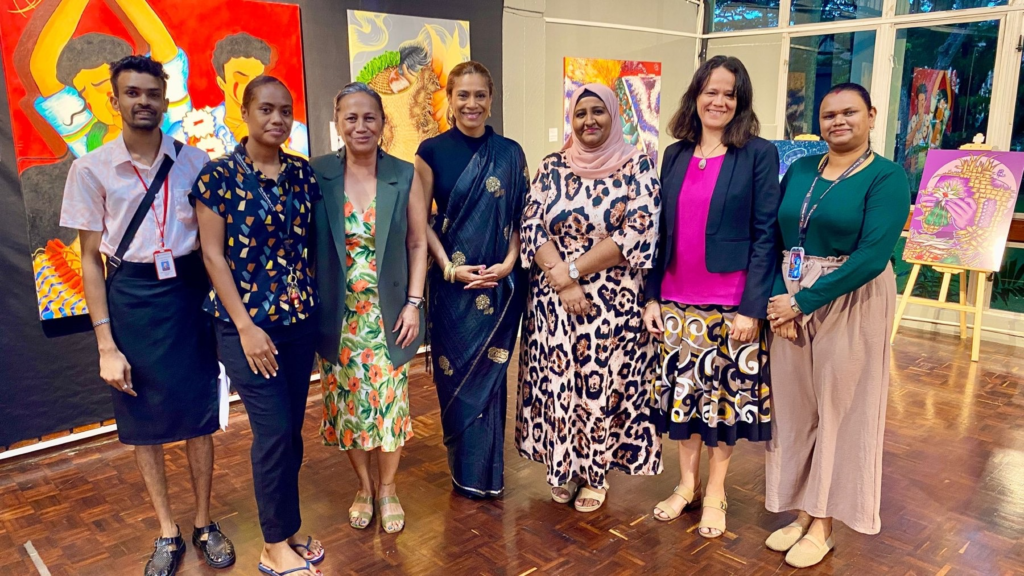
SUVA, Fiji – On the evening of 14 May 2026, the University of Fiji’s Suva Central Campus hosted Emergent, the first solo exhibition of young local Fijian artist Hefrani Barnes. The event served as both a cultural milestone and a platform for urgent social commentary, expressed through black sand, tapa, and vivid colour. The exhibition’s title, derived from the Latin emergere-to bring forth, to bring to light-reflects Barnes’ personal and artistic journey.
Living with epilepsy, the artist has produced twenty works that address climate disasters, fuel crises, bodily autonomy, and regional conflict. “Her storytelling stood out to me,” said Letila Mitchell, former director of the Fiji Arts Council, founder of the Pacific Arts Alliance, and chief guest of the evening. “It wasn’t just art meant to pretty up someone’s wall. Each of her pieces was a conversation about a real issue.” Mitchell noted the significance of the moment for a young artist from Fiji, where few practitioners exist in the contemporary arts space. “It’s a very hard career to undertake,” she added. “But we carry knowledge and stories from one generation to the next.” Barnes’ mother, Maureen Penjueli, spoke of the personal cost behind the collection. “She suffers from epilepsy, and she has delivered this entire twenty-plus collection through blood, sweat and tears,” Penjueli said. “This is a very important moment for her and her career.” She also called on parents to support children pursuing creative paths. “The arts doesn’t get much support in Fiji through our schooling system. People tend to look down at arts as not a pathway for a career.
But for children with deep love and passion, parents must be there to journey with them.” Ilana Burness, Campus Coordinator for the University of Fiji’s Suva Central Campus, explained the institution’s role in hosting the exhibition. “Art allows people to question, to reimagine, and to create meaning beyond traditional academic frameworks,” she said. “University art spaces can become cultural incubators. They create visibility for local artists outside of commercial galleries and build a professional arts ecosystem.” Artist-in-residence Mason Lee also acknowledged the University’s support for local artists and said creative talent in Fiji often goes unrecognised. “University of Fiji has changed that,” Lee said. “The support and belief they have given me has created a space where artists can lead and showcase their work.” Lee added that art remains deeply connected to culture, identity and storytelling. “Culture, tradition and identity are influenced by art,” he said. “Creation is art and it mirrors society in various forms.” The exhibition was funded by the Pacific Island Feminists Alliance for Climate Justice (PIFa4CJ) in partnership with the University of Fiji. Barnes’ work deliberately juxtaposes everyday materials-black sand from Wailoaloa Beach in Nadi, coconut husk, bark-with culturally significant items such as tapa, kuta, and ‘apei mats. The exhibition notes ask: “What is of common value to all? Justice, hope, love, and a duty of care for the living and non-living.” Hon. Lynda Tabuya, Minister for Information, Environment and Climate Change, attended the exhibition and described a personal connection to the artist. “I’ve known Hefrani since she was born,” Tabuya said. “For UniFiji to bring her into the space of academia shows that academia is not just limited to books and articles. It is also the expression of art-non-verbal, pictorial, and vital.” Tabuya was particularly struck by the thematic range of the works. “She covered the fuel crisis, evacuations during climate disasters, her own ethnicity, and how to recycle our own fabric, natural sinews, tapa, and mats,” she said. “And the colours capture who we Fijians are. We are happy people, and we need to reflect that.” The Minister further challenged the arts to reclaim digital spaces. “There is so much darkness on social media-cyberbullying, negativity. We need to bring beauty and colour back into that dark space.” Barnes, though unable to attend in person, shared her perspective through the program.
When asked about her inspirations, she stated: “Faith, nature, human emotions, awareness, culture and tradition. These guide my path as an artist.” On the challenges facing young Fijian artists, she responded simply: “Lack of support to be recognised.” Her advice to students was direct: “Think twice. Or if you’re bold enough, take up the role and make it count.” The evening’s program, led by Master of Ceremonies Lawrence Singh, included a welcome address, keynote remarks by Ilana Burness, and a tribute from Letila Mitchell on female perspectives in radical and experimental art forms. As Mitchell concluded: “Art carries our identity. It’s a positive way of showing who we are without discriminating against others. It connects cultures together.” On a warm evening in Suva, Hefrani Barnes’ Emergent did exactly that-bringing forth, into the light, what had long been submerged.

